
Oil Viscosity Grades Explained: ISO VG, SAE and Why ISO 100 Equals SAE 30
Walk through any workshop and you’ll find oils labelled in what looks like three different languages. The engine oil says 20W-50. The compressor oil says ISO 100. The gear oil says SAE 90. Yet the compressor manual asks for “SAE 30”, which turns out to be the same as ISO 100, and an SAE 90 gear oil is about as thick as an SAE 40–50 engine oil. So what do all these numbers actually mean, and where did they come from? This guide explains viscosity grades in plain English, with a little history along the way.
What is viscosity?
Viscosity is simply a liquid’s resistance to flow: its thickness. Water pours easily because it has low viscosity; honey pours slowly because it has high viscosity. For a lubricant, viscosity is the single most important property. Too thin and the oil film breaks down, letting metal touch metal. Too thick and it won’t flow to where it’s needed, wastes energy, and struggles when cold.
Oil viscosity is usually measured as kinematic viscosity: how fast the oil flows under its own weight. The unit is the centistoke (cSt), which is the same as mm²/s. For reference, water at 20°C is about 1 cSt.
Temperature changes everything
Every oil thins as it heats up and thickens as it cools. That’s why a viscosity number means nothing unless you know the temperature it was measured at, and why the different grading systems measure at different temperatures. How much an oil thins with heat is measured by its viscosity index (VI). A high VI means the viscosity stays more stable across temperatures; a low VI means it changes a lot. Synthetic oils usually have a higher VI than mineral oils.
A short history of oil grades
1880s Oils were described as “light”, “medium” or “heavy”. Engineers began measuring viscosity with flow-cup viscometers, timing how long a set volume of oil took to drain through a small hole. Each country had its own: Redwood seconds in Britain, named after the chemist Sir Boverton Redwood; Engler degrees in Germany; and later Saybolt seconds in the United States.
1887 Millers Oils is founded in Brighouse, West Yorkshire, in the era of these early viscosity measurements.
1911 The Society of Automotive Engineers (SAE) publishes its first engine oil viscosity classification, the ancestor of today’s SAE J300, giving motorists simple numbers instead of flow times.
1929 Chemists E.W. Dean and G.H.B. Davis invent the viscosity index, comparing oils against a Pennsylvanian crude that thinned relatively little with heat (VI 100) and a Gulf Coast crude that thinned a lot (VI 0).
1950s “W” grades arrive for cold-weather performance, and multigrade oils such as 10W-30 follow, working like a thin oil when cold and a thicker oil when hot. The W stands for winter, not “weight”.
1975 The International Organization for Standardization publishes ISO 3448, giving industrial oils one worldwide system of viscosity grades measured at 40°C.
Today SAE keeps adding thinner grades for fuel-efficient engines (SAE 16 in 2013, then SAE 12 and SAE 8), while the old flow-cup “seconds” live on mainly in older manuals.
Old reference temperatures were quoted in Fahrenheit, with 100°F and 210°F common benchmarks. Today’s standard measuring points of 40°C and 100°C are their metric successors.
How ISO viscosity grades (ISO VG) work
ISO VG is used for industrial oils: hydraulic, compressor, gear, slideway and turbine oils. It’s the simplest system of all: the grade number is the oil’s viscosity in centistokes at 40°C, give or take 10%. So an ISO VG 46 oil is 41.4–50.6 cSt at 40°C, and an ISO VG 100 oil is 90–110 cSt.
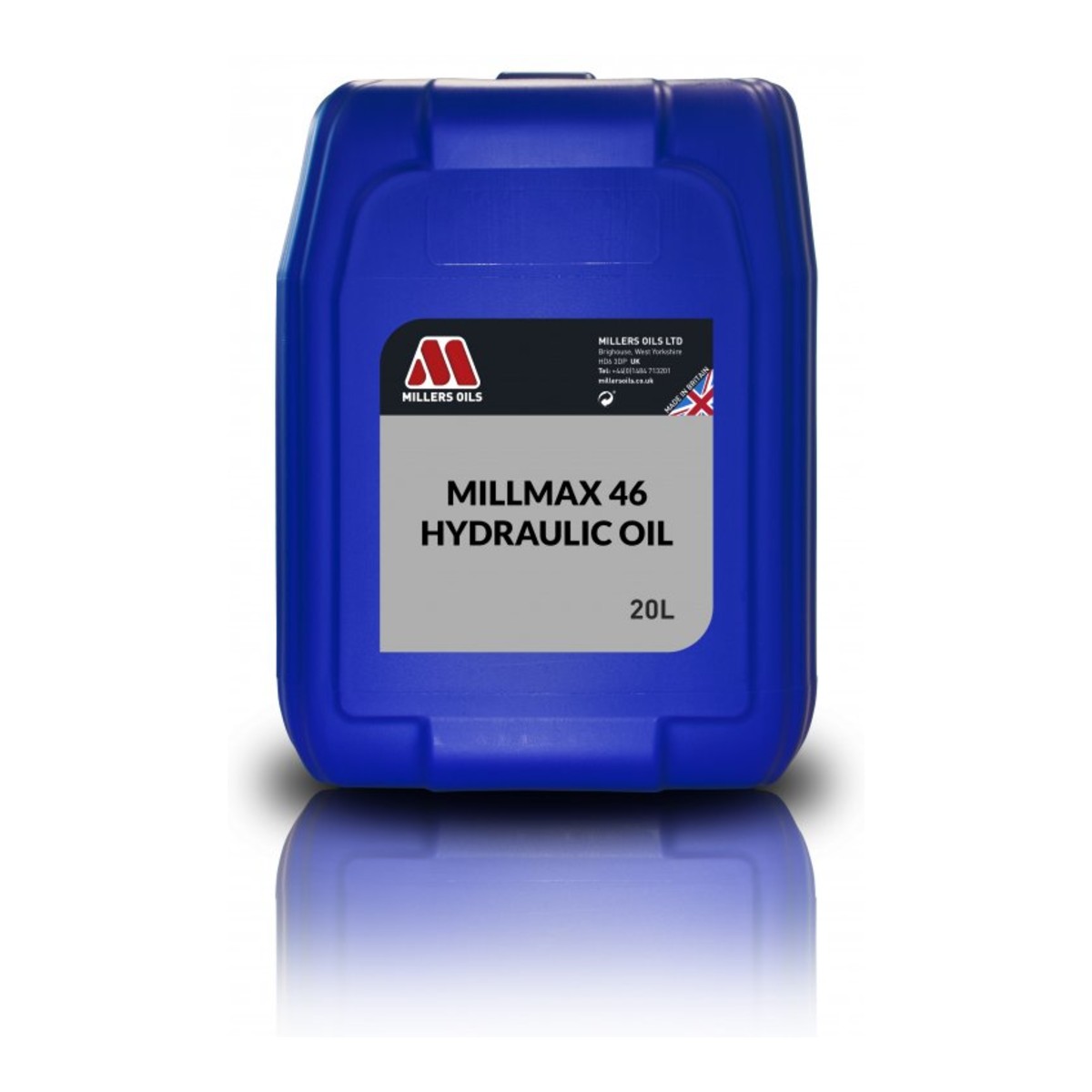
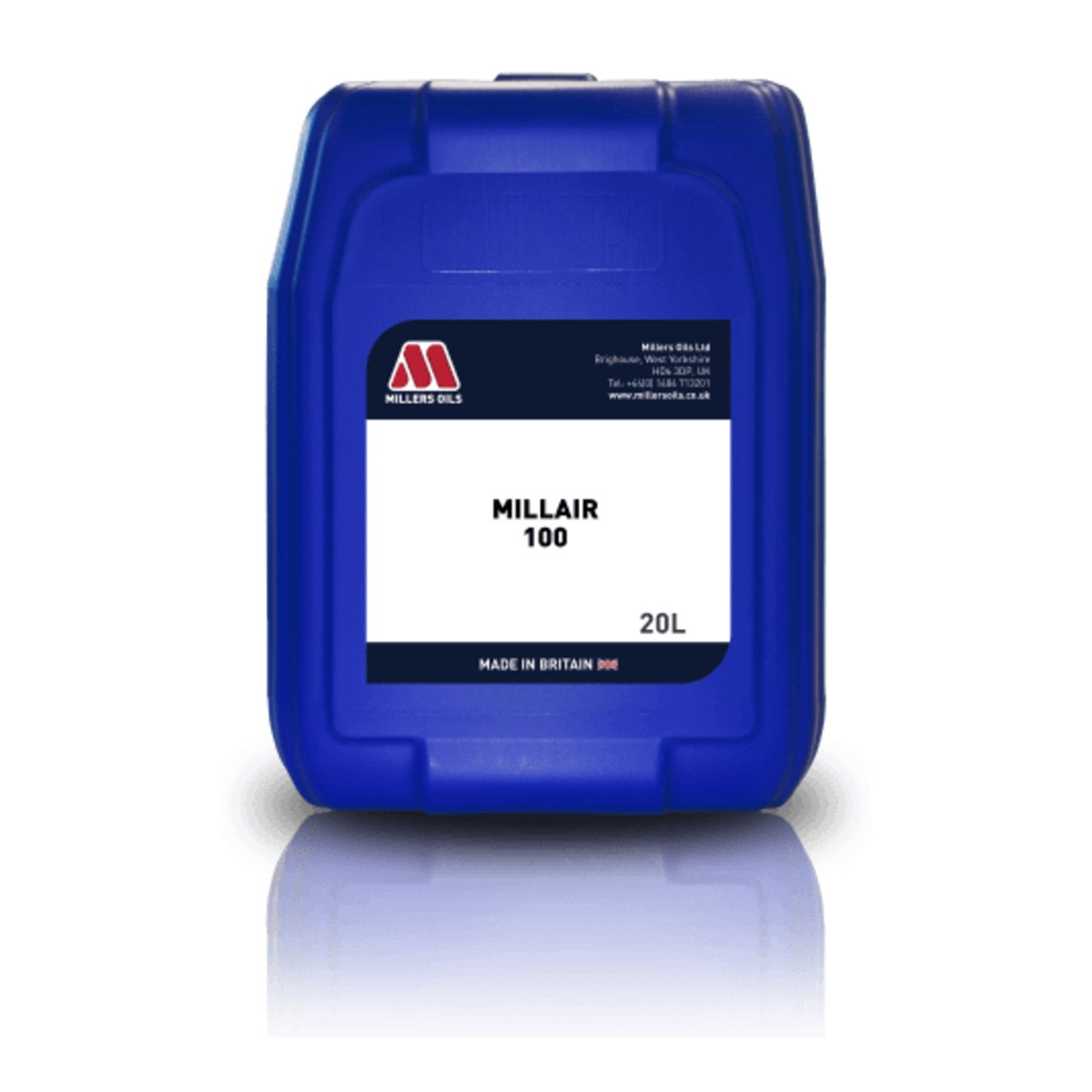
There are 20 grades, from ISO VG 2 to ISO VG 3200, and each is roughly 50% thicker than the one before: 22, 32, 46, 68, 100, 150, 220, 320, 460, 680 and so on. 40°C was chosen because it’s close to the temperature many industrial machines actually run at. For example, Millers Millmax 46 is an ISO VG 46 hydraulic oil, and Millair 100 is an ISO VG 100 compressor oil.
How SAE engine oil grades work
SAE J300 grades engine oils by how they behave at engine temperatures. The “hot” number (20, 30, 40, 50 and so on) is defined by viscosity at 100°C, close to a running engine’s oil temperature. Each grade is a band rather than a single value:
| SAE grade | Viscosity at 100°C (cSt) |
|---|---|
| SAE 20 | 6.9 to under 9.3 |
| SAE 30 | 9.3 to under 12.5 |
| SAE 40 | 12.5 to under 16.3 |
| SAE 50 | 16.3 to under 21.9 |
| SAE 60 | 21.9 to under 26.1 |
The “W” number (0W, 5W, 10W and so on) comes from low-temperature cranking and pumping tests, so it tells you how easily the oil flows on a cold start. A multigrade such as 20W-50 meets both a winter grade and a hot grade. The standard also sets a minimum high-temperature, high-shear viscosity for each grade, which ISO grades don’t have. For more on reading engine oil numbers, see engine oil grades explained.
Gear oils: a scale of their own
Gear oils have their own SAE scale, SAE J306, and its numbers are deliberately different so gear oil and engine oil can’t be confused. An SAE 90 gear oil is 13.5 to under 18.5 cSt at 100°C, which is about the same thickness as an SAE 40–50 engine oil, not almost twice as thick as it sounds. An SAE 140 gear oil is 24.0 to under 32.5 cSt. That’s why a Classic Gear Oil EP 80W-90 isn’t nearly as thick as its number suggests. Read more in our classic gear oil guide.
So why does ISO 100 equal SAE 30?
Because they’re the same oil, measured at two different temperatures. A typical mineral oil with a viscosity index of about 95–105 that measures around 100 cSt at 40°C thins to roughly 11–12 cSt at 100°C. That falls right in the middle of the SAE 30 band.
It’s only an approximate match, for three reasons. The SAE 30 band is wide, so a thin SAE 30 sits nearer ISO 68 and a thick one nearer ISO 150. A high-VI synthetic thins less, so it can be ISO 68 at 40°C and still be SAE 30 at 100°C. And SAE grades include cold and high-shear tests that ISO grades don’t.
Approximate conversion chart
This chart is a guide for typical mineral oils. Use it to understand the numbers, not to swap one type of oil for another.
| ISO VG (40°C) | Approx. SAE engine grade | Approx. SAE gear grade | Typical Millers example |
|---|---|---|---|
| 32 | 10W | – | Millmax 32, Millair 32 |
| 46 | 15W–20 | – | Millmax 46, Millair 46 |
| 68 | 20 | – | Millmax 68, Millair 68 |
| 100 | 30 | – | Millair 100 |
| 150 | 40 | 90 (lighter end) | Millair 150 |
| 220 | 50 | 90 | – |
| 320 | 60 | – | – |
| 460–680 | – | 140 | – |
Why this matters in real life
- A compressor manual asks for “SAE 30”. The ISO equivalent is ISO 100, so Millair 100 is the match. See our compressor oil guide.
- A hydraulic system needs ISO 46. That’s roughly the thickness of an SAE 15W–20 engine oil, but you still need a proper hydraulic oil such as Millmax 46. See our hydraulic oil guide.
- A gearbox says SAE 90. Don’t be put off by the big number: it’s a gear oil scale, and it’s about as thick as an SAE 40–50 engine oil.
Viscosity FAQs
What does ISO VG mean?
ISO VG stands for ISO viscosity grade. It’s the international system for industrial oils, set out in ISO 3448. The number is the oil’s kinematic viscosity in centistokes at 40°C, within ±10%, so ISO VG 46 is about 46 cSt at 40°C.
Is ISO 100 the same as SAE 30?
Roughly, yes. A typical mineral oil of about 100 cSt at 40°C thins to around 11–12 cSt at 100°C, which falls in the SAE 30 band of 9.3 to under 12.5 cSt. It’s an approximate match, because the two systems measure at different temperatures and SAE grades include extra tests.
What does the W stand for in 10W-40?
Winter. The W grade shows how well the oil flows and pumps when cold, based on low-temperature tests. The second number is the grade at the engine’s hot running temperature, measured at 100°C.
Why are gear oil numbers so much higher than engine oil numbers?
Gear oils use a separate SAE scale (J306) with deliberately different numbers, so they can’t be confused with engine oils. An SAE 90 gear oil is about as thick as an SAE 40–50 engine oil at 100°C.
What is viscosity index?
Viscosity index (VI) measures how much an oil’s viscosity changes with temperature. A higher VI means the oil thins less as it heats up. It was devised in 1929 by E.W. Dean and G.H.B. Davis, and synthetic oils usually have a higher VI than mineral oils.
If two oils have the same viscosity, can I swap them?
No. Viscosity tells you the grade, not the type. Engine, hydraulic, compressor and gear oils have very different additives for their jobs, so always use the correct type of oil in the correct grade.
More guides: engine oil grades explained, hydraulic oil guide, compressor oil guide and classic gear oil explained.