Octane Booster Explained: How Millers CVL Extra Works (And Why It’s One of the Best)
If you have ever searched for an octane booster, you were probably chasing one of a few things: stopping that tell-tale pinking under load, unlocking a little more timing or boost, or protecting an older engine that was born on leaded fuel. Millers Oils CVL Extra does all three — and it is one of the most respected octane boosters in the classic and competition world. Here is how it works, and why it earns its place in the boot of so many enthusiasts.
What does an octane booster actually do?
Petrol’s octane rating is simply a measure of how well it resists knock — also called detonation or pinking — where the fuel ignites uncontrollably before the spark plug fires. Knock is where power goes to die, and in a hard-worked engine it can do real damage. A good octane booster raises the fuel’s resistance to knock, which lets an engine run more advanced ignition timing, higher boost or higher compression safely. That is where the extra performance and smoothness comes from.
The catch is that plenty of bottles on the shelf promise big numbers and deliver almost nothing. The gains are only worth having if the product genuinely shifts the octane figure — and can back it up.
How Millers CVL Extra works
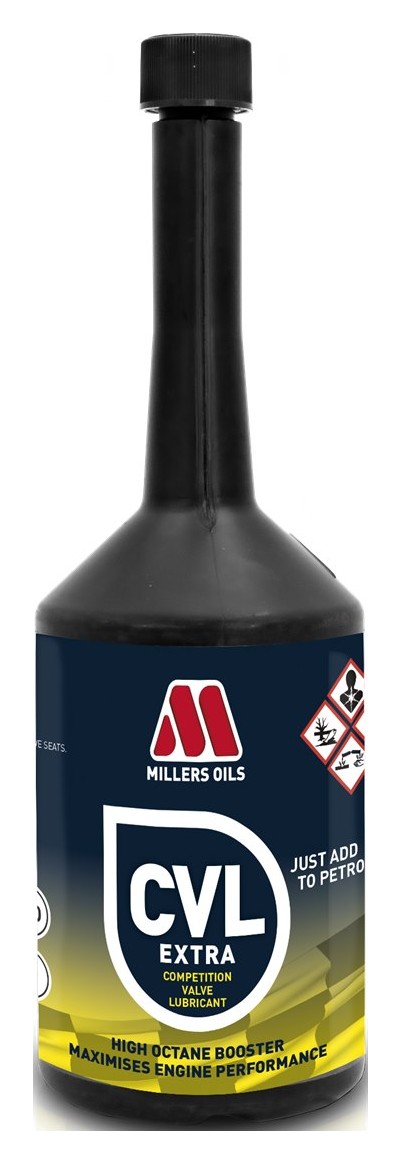
CVL stands for Competition Valve Lubricant, and that name is the clue to why it is different from a plain octane additive. It does two jobs at once:
- Raises octane — CVL Extra adds up to 4 octane numbers to the base fuel, giving strong protection against knock and detonation.
- Controls the flame front like lead — it gives similar combustion control to the tetraethyl lead used in old fuels, which is what lets an engine run more advanced ignition timing without pinking.
- Protects the valves — it lubricates the upper cylinder and valve seats, guarding against valve seat recession, the wear that hits engines designed for leaded petrol once they run on modern unleaded.
- Fights ethanol — it helps protect the fuel system against the corrosive effects of the ethanol in today’s E5 and E10 unleaded.
So it is not just a power additive — it is a genuine safeguard for engines that were never designed for the fuel we buy today.
Why Millers CVL is one of the best octane boosters
Millers Oils has been blending performance and motorsport lubricants in Britain since 1887, and CVL Extra comes from that competition pedigree rather than a marketing department. Three things set it apart:
- It actually moves the needle — up to 4 octane numbers is a real, usable gain, not a token bump.
- It does two jobs — octane and valve protection in one bottle, so a classic engine gets performance and preservation together.
- It fits almost anything — safe with leaded, unleaded, lead-replacement and octane-enhanced fuels, and fine on E5 and E10, from a Group B icon to a modern turbo with knock sensors and a catalytic converter.
Who should be using it?
- Classic and competition cars — especially anything originally run on leaded fuel that now lives on unleaded.
- Modified and tuned engines — where you want more timing, more boost or higher compression without knock.
- Track-day and race engines — for consistent, detonation-free power when it matters.
- Anyone worried about ethanol — E10 in particular is hard on older fuel systems.
How to use CVL Extra
It could not be simpler: one 500 ml bottle treats up to 20 litres of fuel. Add it to the tank before you fill up so it mixes properly. It comes as a single 500 ml bottle or a case of ten — handy if you are treating every tank through the season.
Not sure which additive you need? Use our 30-second fuel additive picker for petrol, diesel and classic engines.
Octane booster FAQs
Do octane boosters actually work?
A good one does — the key is whether it genuinely raises the fuel’s octane rating. Millers CVL Extra adds up to 4 octane numbers to the base fuel, a real, measurable gain that helps stop knock and lets an engine run more timing or boost safely. Cheaper boosters often barely move the figure, which is why the quality of the additive matters.
How much octane does CVL Extra add?
Up to 4 octane numbers over your base fuel. So a tank of 95 RON pump petrol can be lifted towards 99 RON — enough to make a real difference to a high-compression, tuned or classic engine.
Will an octane booster give me more power?
Not by magic — but by preventing knock it lets an engine run the ignition timing and boost it was designed or tuned for, without pinking. That is where you feel smoother, more consistent power, especially under load.
Is octane booster safe for modern cars and catalytic converters?
Yes. CVL Extra is safe for modern engines with knock sensors and catalytic converters, as well as classic and competition units, and it works with leaded, unleaded, lead-replacement and octane-enhanced fuels.
Will it protect against E10 ethanol?
Yes — CVL Extra helps protect the fuel system against the corrosive effects of the ethanol in modern E5 and E10 unleaded, a common worry now E10 is the standard grade at the pumps.
What is the difference between an octane booster and a lead replacement?
An octane booster raises the fuel’s resistance to knock so you can run more timing or boost. A lead replacement such as Millers VSPe Power Plus mainly protects the valve seats on engines built for leaded fuel. CVL Extra does a bit of both — it boosts octane and lubricates the valves — but for dedicated lead replacement, VSPe is the specific choice.
Running a classic that needs lead replacement rather than an octane lift? Take a look at Millers VSPe Power Plus, or drop us a line and we will point you to the right bottle.
Related guides: E10 petrol problems for older engines · Lead replacement & E10 protection for classics · VSPe vs Valvemaster · All fuel guides