Antifreeze for Central Heating: When You Need It, Which Glycol and How Much
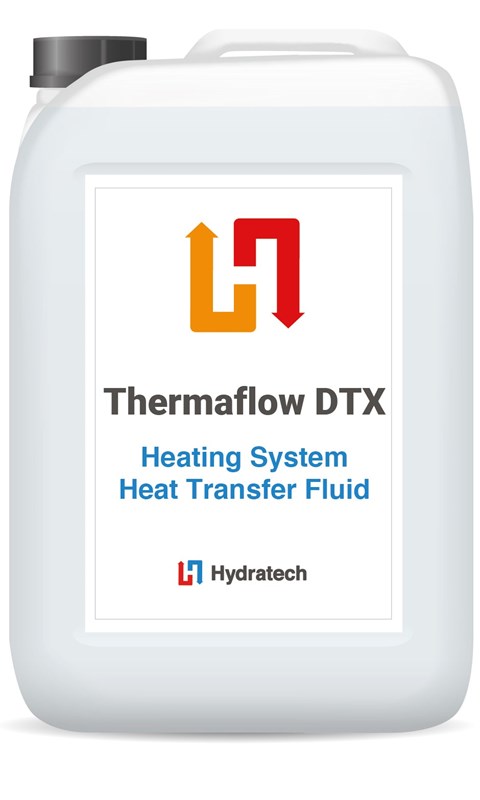
Most central heating systems run on treated water. But where a system is at risk of freezing, it can be filled with a glycol-based antifreeze for central heating: a heat transfer fluid that lowers the freezing point and protects the system from corrosion inside. This guide explains when a heating system needs it, the different types, and how much to add, using Hydratech’s Thermaflow range for domestic and commercial heating and LTHW (low-temperature hot water) systems.
When does a central heating system need antifreeze?
A heating system that runs every day in a heated building is usually protected by its own warmth. The risk comes when water sits still in a cold place. Typical examples are pipework running through attics, garages or outbuildings, boilers and pipework outside the heated envelope of the building, holiday homes and other buildings left unheated over the winter, and commercial or LTHW systems with pipework in plant rooms or exposed runs. If any of that water freezes, it can split pipes, radiators and heat exchangers.
A heating antifreeze does two jobs: the glycol lowers the freezing point, and the inhibitors in it protect the metals in the system against corrosion, scale and biological fouling. Thermaflow fluids have a long-life, high-temperature-rated formulation with inhibitors that exceed the ASTM D1384 corrosion standard. Before adding any antifreeze, check your boiler or heating manufacturer’s guidance on which fluids and strengths they allow.
The types of central heating antifreeze
The ratings below are Hydratech’s own, from A (best) to E.
| Type | Thermaflow fluid | Toxicity | Efficiency | Antifreeze | % for −10°C | Best for |
|---|---|---|---|---|---|---|
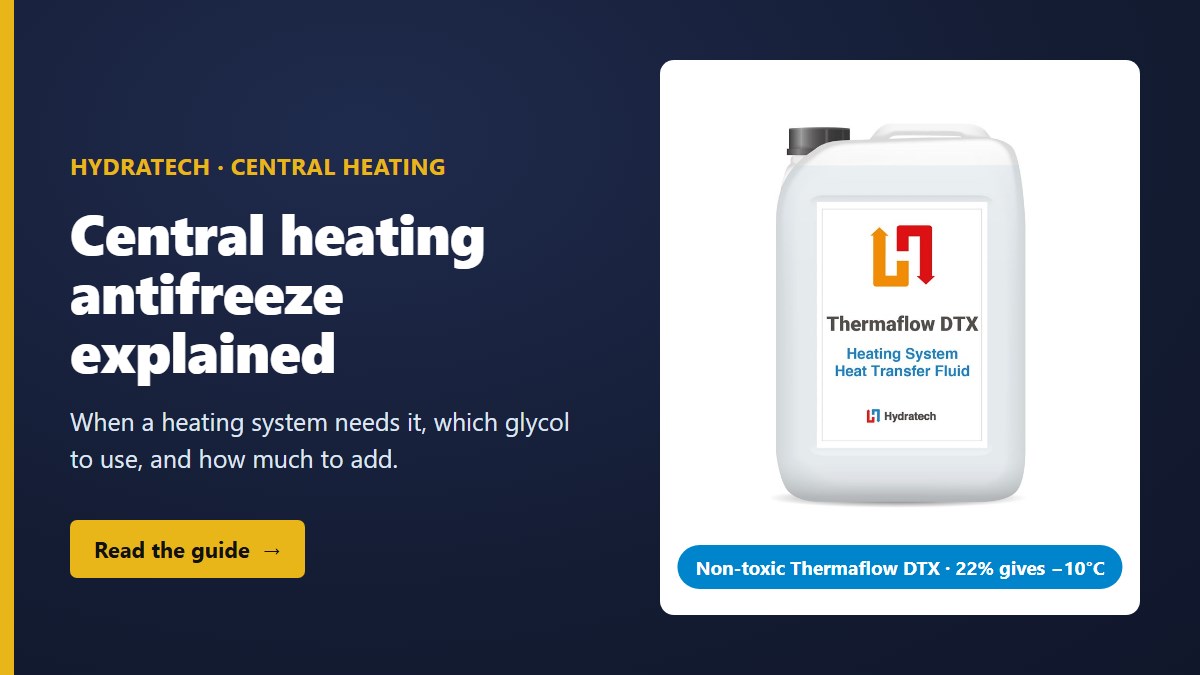
| Detoxified ethylene glycol (DTX) | Thermaflow DTX | A Non-toxic | B | A | 22% | Most systems, homes and new fills |
| Propylene glycol (MPG) | Thermaflow TPF (to order) | A Non-toxic | C | B | 25% | Where MPG is specified, or topping up an MPG system |
| Ethylene glycol (MEG) | Thermaflow CMF (to order) | D Harmful | B | A | 25% min. | Commercial systems where toxicity isn’t an issue |
| Plant-based | Thermaflow VT3 (to order) | A Non-toxic | C | B | 25% | Where low environmental impact is the priority |
Why Thermaflow DTX?
Ethylene glycol is the better heat transfer fluid: it moves heat more efficiently, pumps more easily at low temperatures, and you need less of it for the same frost protection. Its drawback is toxicity. Thermaflow DTX adds Hydratech’s patented DeTox™ additive and has been tested and classified non-toxic by an EPA-certified laboratory, so you get ethylene glycol’s performance with a non-toxic classification. Hydratech rates it more cost-effective than propylene glycol and much less toxic than plain ethylene glycol.
Thermaflow TPF (propylene glycol) is the traditional non-toxic choice but needs a higher concentration. Thermaflow CMF is plain inhibited ethylene glycol: efficient and economical, but classed as harmful, so only for systems where toxicity isn’t an issue. Thermaflow VT3 is based on refined vegetable extracts.
How much antifreeze do I add?
Antifreeze is measured as a percentage of the total system volume, not as a ratio to the water you add. Decide on the lowest temperature you need to protect against, then read off the strength.
| Frost protection | Thermaflow DTX | Thermaflow TPF | Thermaflow CMF | Thermaflow VT3 |
|---|---|---|---|---|
| −10°C | 22% | 25% | 20%* | 25% |
| −15°C | 28% | 33% | 27% | 32% |
| −20°C | 33% | 39% | 32% | 38% |
| −25°C | 38% | 44% | 37% | 43% |
| −30°C | 42% | 48.5% | 41% | 48% |
| −35°C | 46% | 52.5% | 45% | 52% |
| Minimum dose | 22% | 25% | 25% | 25% |
Source: Hydratech Thermaflow data sheets. *Hydratech’s minimum dose for Thermaflow CMF is 25%. The maximum does not normally exceed 60%.
How to fill a heating system with antifreeze
Clean the system first
Hydratech advises that all pipework should be clean and free of debris and biological contamination before commissioning, as set out in BSRIA guide BG 29/2012. Fresh antifreeze in a dirty system won’t protect it properly.
Work out the volume and strength
Find the total system volume (boiler, pipework, radiators and any buffer or cylinder coil) and choose the protection you need from the table. Multiply the volume by the percentage.
Use the right water
Dilute with deionised, distilled or ultrapure water. Avoid water high in calcium salts or chlorides, which work against the inhibitors.
Fill and keep air out
Fill following your boiler or heating manufacturer’s instructions. Air ingress should be kept to a minimum to limit corrosion, and a pressurised (sealed) system is best.
Check the strength
Once it has circulated, check the concentration with a recently calibrated refractometer. For Thermaflow DTX, a reading of 1.35600 is 22% (−10°C) and 1.36700 is 33% (−20°C).
Mistakes to avoid
- Mixing different fluids. Top up with the same type of fluid that’s already in the system. If you don’t know what’s in it, ask us before adding anything.
- Forgetting part of the volume. Radiators, cylinder coils and buffer tanks all hold fluid. Underestimate the volume and the mix ends up too weak.
- Diluting with hard tap water. Use deionised, distilled or ultrapure water.
- Going below the minimum dose. Below 22% for DTX (25% for TPF, CMF and VT3), you lose protection.
- Overdoing it. The maximum doesn’t normally exceed 60%.
- Using a harmful glycol where it doesn’t belong. Plain ethylene glycol (Thermaflow CMF) is classed as harmful. In homes, use a non-toxic fluid.
Hydratech Thermaflow
Central heating antifreeze FAQs
Do I need antifreeze in my central heating?
Only if part of the system is at risk of freezing: for example pipework in attics, garages or outbuildings, boilers outside the heated building, or buildings left unheated over winter. Check your boiler manufacturer’s guidance first.
How much antifreeze do I put in a heating system?
It’s a percentage of the total system volume. With Thermaflow DTX, 22% gives −10°C and 33% gives −20°C. A 100-litre system protected to −15°C needs 28 litres of DTX.
Is central heating antifreeze toxic?
It depends on the type. Thermaflow DTX, TPF and VT3 are classified non-toxic. Thermaflow CMF, plain ethylene glycol, is classed as harmful and is for systems where toxicity isn’t an issue.
What’s the difference between DTX and propylene glycol?
Both are non-toxic. DTX is ethylene glycol with Hydratech’s DeTox™ additive: it transfers heat better, pumps more easily when cold, and needs a lower concentration (22% against 25% for −10°C). Propylene glycol is the traditional choice where it’s specified.
Can I mix different heating antifreezes?
Top up with the same type of fluid that’s already in the system. If you want to change type, or you don’t know what’s in the system, contact us first.
How long does Thermaflow keep?
Unopened, at least 3 years in sealed containers, stored below 40°C and out of direct sunlight. In a working system, Hydratech recommends periodic sampling and testing to make sure the inhibitor levels are being maintained.