Winterising a Caravan, Motorhome or Boat: Which Antifreeze and How Strong
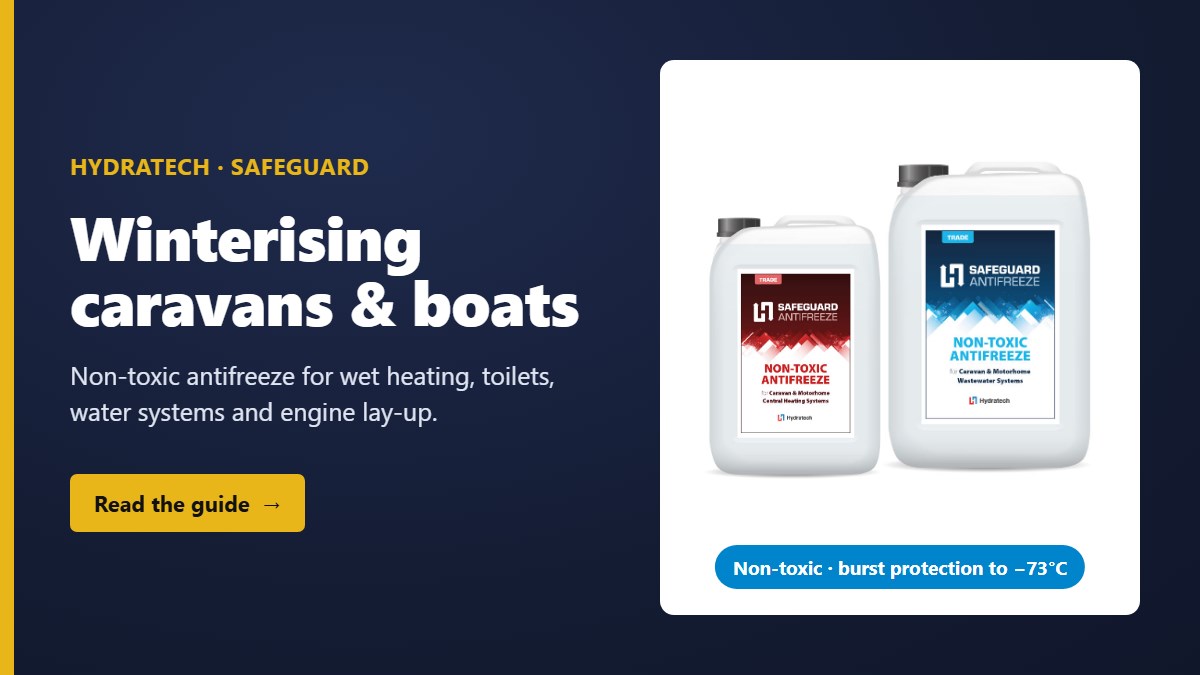
Whether your caravan sits on a park over the winter or your boat is laid up until spring, any water left in its pipes, tanks, pumps, toilets or engine can freeze and split something expensive. Winterising means draining what you can and protecting the rest with antifreeze. This guide explains which antifreeze to use where, how strong to mix it, and the mistakes to avoid, using Hydratech’s Safeguard range, which we can order in for you.
Why winterise at all?
Water expands as it freezes. In a caravan, motorhome or boat, that means split pipes and fittings, cracked pumps and valves, damaged toilets and tanks, and frost damage to a wet heating system. Draining helps, but water often stays in low points, traps and pumps. Filling those parts with a suitable antifreeze, or protecting a heating system with the right strength of fluid, stops that last bit of water doing the damage.
Why not use car antifreeze?
Car antifreeze is made for engine cooling systems. The Safeguard range is non-toxic and readily biodegradable (90% over ten days), which Hydratech points out makes it safer for the application and for the local environment than standard car or automotive antifreeze. That matters when the fluid ends up in a toilet, a waste tank or a marina. Safeguard also contains multi-metal and multi-function inhibitors against corrosion, scaling and biological fouling, and Hydratech says it is used and approved by the UK’s leading park operators and chandlers.
Which Safeguard do I need?
| Safeguard fluid | Use it for | Protection |
|---|---|---|
| Heating Trade | Wet (hydronic) heating systems in static caravans, touring caravans and motorhomes. Compatible with all metals and materials commonly used in caravan wet heating systems. | Frost protection to −50°C at 60% |
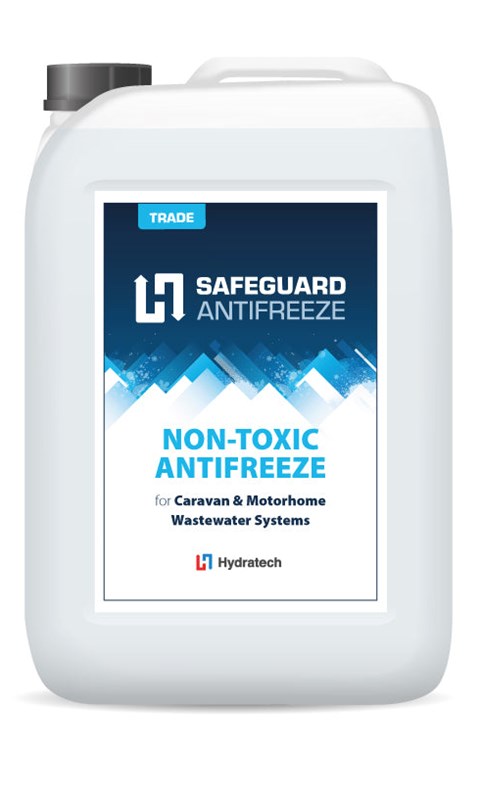
| Wastewater Trade | Toilets and water systems in static caravans, touring caravans, motorhomes and boats, including tanks, fittings, valves and pumps. | Freeze point −46°C, burst protection to −73°C at 50% |
| Marine Trade | Boat water systems, toilets and engines during winter lay-up. Safe for aluminium, copper, brass and all types of plastic. | Freeze point −46°C, burst protection to −73°C at 50% |
Freeze point and burst protection explained
Hydratech gives two figures for Safeguard Wastewater and Marine. The freeze point is where the mix starts to form ice crystals. Below that it thickens to a slush, but the burst protection figure is the lowest temperature Hydratech rates it to stop PVC or copper pipework bursting. So even a fairly weak mix gives real protection against split pipes.
| Wastewater & Marine Trade (% of mix) | Freeze point | Burst protection (PVC) | Burst protection (copper) |
|---|---|---|---|
| 12% | −5°C | −15°C | −38°C |
| 21% | −11°C | −23°C | −46°C |
| 33% | −23°C | −35°C | −57°C |
| 42% | −34°C | −48°C | −65°C |
| 50% | −46°C | −62°C | −73°C |
| Heating Trade (% of system volume) | Frost protection |
|---|---|
| 30% | −15°C |
| 35% | −20°C |
| 40% | −25°C |
| 45% | −30°C |
| 50% | −40°C |
| 60% | −50°C |
Source: Hydratech Safeguard data sheets. Hydratech recommends checking the strength with a recently calibrated refractometer.
Winterising a caravan or motorhome
Read the handbook first
Every caravan and motorhome is plumbed differently. Your handbook or dealer will tell you which drain points, taps and valves to open, and whether the water heater and pump have their own drain-down procedure.
Drain the fresh water system
Empty the fresh water tank, pipes and water heater as the handbook describes, so there’s as little water left in the system as possible.
Protect the toilet, tanks and traps
Use Safeguard Wastewater Trade, mixed to the protection you need from the table above, in the toilet, waste tank and anywhere water can sit, such as sink and shower traps.
Check the wet heating system
If your caravan has a wet (radiator) heating system, check what fluid is in it and that it’s at the strength the heating manufacturer specifies. Safeguard Heating Trade is made for caravan wet heating systems: top up or refill following the heating manufacturer’s instructions.
Recommission properly in spring
Before using the water system again, follow your handbook’s recommissioning steps and flush the fresh water system thoroughly.
Laying up a boat for winter
Follow the engine and boat manufacturer
Use your engine manufacturer’s lay-up procedure for the engine, and the boat builder’s instructions for the water system and heads.
Drain the fresh water system
Empty tanks, pipes and the calorifier or water heater as far as you can.
Protect water systems, heads and the engine
Safeguard Marine Trade is formulated for marine water systems, toilets and engine storage during winter lay-up. It is safe for aluminium, copper, brass and all types of plastic, and won’t damage rubber, hose or gaskets.
Choose the right strength
Use the table above. For example, a 33% mix has a freeze point of −23°C and burst protection to −35°C in PVC and −57°C in copper.
Mistakes to avoid
- Using car antifreeze. Use a non-toxic, biodegradable antifreeze made for caravans, motorhomes and boats.
- Leaving water in low points. Water trapped in pumps, traps and dips in the pipework can still freeze. Drain thoroughly before adding antifreeze.
- Mixing too weak. Water left in the system dilutes the antifreeze. Allow for it, and check the strength with a refractometer if you can.
- Forgetting the wet heating system. If your caravan has one, check what fluid is in it and that it’s at the strength the heating manufacturer specifies.
- Skipping the spring flush. Flush the fresh water system thoroughly before using it again.
Ordering Safeguard
Winterising FAQs
What antifreeze should I use to winterise a caravan?
A non-toxic, biodegradable antifreeze made for caravans. Hydratech’s Safeguard Wastewater Trade is for toilets, tanks and water systems, and Safeguard Heating Trade is for wet heating systems.
Can I use car antifreeze in a caravan or boat?
It isn’t recommended. Safeguard is non-toxic and biodegradable, which Hydratech points out makes it safer for the application and the local environment than standard car or automotive antifreeze.
What’s the difference between freeze point and burst protection?
The freeze point is where the mix starts to form ice crystals. Burst protection is the lowest temperature Hydratech rates the mix to stop pipework bursting. At 50%, Safeguard Wastewater and Marine Trade have a freeze point of −46°C and burst protection to −73°C in copper.
How strong should I mix Safeguard?
It depends on the protection you need. For Wastewater and Marine Trade, 21% gives a freeze point of −11°C and 33% gives −23°C. For Heating Trade, 35% gives −20°C. The full tables are above.
Is Safeguard safe for rubber seals and plastic pipes?
Yes. Hydratech says it is safe for aluminium, copper, brass and all types of plastic, and the inhibitor formulation won’t damage rubber, hose or gasket materials.
Can I buy Safeguard in Ireland?
Yes. We order it in from Hydratech in 5, 10, 20 and 25 litre drums, 205 litre drums and 1000 litre IBCs. Contact us for a price.