Solar Fluid Explained: Ready-Mixed or Concentrate, and How to Fill a Solar System
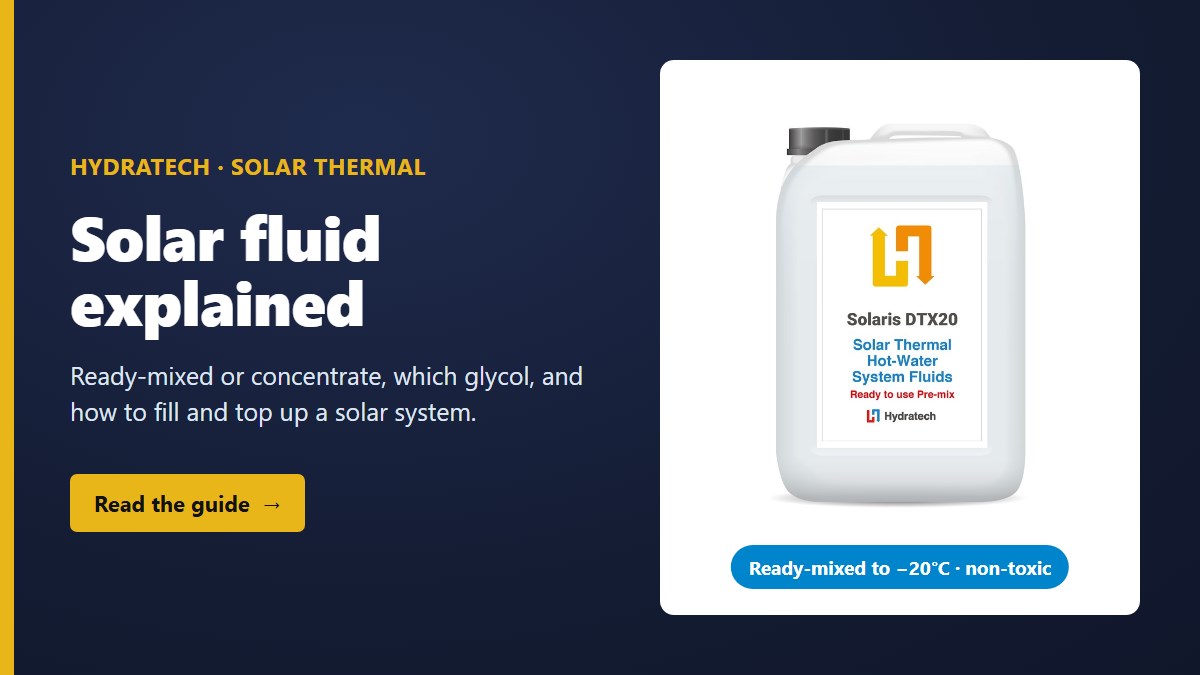
Solar thermal panels heat water using a sealed loop of solar fluid: a glycol-based heat transfer fluid that carries heat from the roof to the hot water cylinder. It has to cope with frost in winter and with very high temperatures in the collectors in summer. This guide explains the choice between ready-mixed and concentrate fluids, which glycol to use, and how to fill and top up a system, using Hydratech’s Solaris range, which we stock in 5 and 20 litre drums.
Why solar thermal systems need a special fluid
A solar collector works at both extremes. On a frosty night, fluid sitting in the panels on the roof can freeze and damage them. On a sunny day when no hot water is being used, the fluid in the collectors can get extremely hot. So a solar fluid needs both antifreeze protection and inhibitors that keep working at high temperatures.
Every Solaris fluid is formulated with extreme-temperature-rated, reversibly evaporable inhibitors, suitable for evacuated tube, flat plate and thermodynamic solar panels. They also contain a high-temperature-rated polyacrylate to prevent sludge and scale, and have been tested in accordance with BS5117 and found to meet the BS6580 and ASTM D1384 corrosion standards. The propylene glycol fluids, Solaris PG20 and PGC, operate efficiently at 170°C for prolonged periods, withstand 200°C for short periods, and their inhibitors withstand stagnation temperatures of 300°C.
The Solaris range compared
There are four Solaris fluids: two ready-mixed and two concentrates, each in a non-toxic detoxified ethylene glycol (DTX) or propylene glycol (PG) version. The ratings are Hydratech’s own, from A (best) to E.
| Fluid | Base | Supplied as | Efficiency | Antifreeze | Frost protection | We stock |
|---|---|---|---|---|---|---|
| Solaris DTX20 | DTX, non-toxic | Ready-mixed | B | A | −20°C | 5L & 20L |
| Solaris PG20 | Propylene glycol, non-toxic | Ready-mixed | C | B | −20°C | 5L & 20L |
| Solaris DTX | DTX, non-toxic | Concentrate | B | A | To −50°C | 5L & 20L |
| Solaris PGC | Propylene glycol, non-toxic | Concentrate | C | C | To −50°C | 5L |
Ready-mixed or concentrate?
Ready-mixed (DTX20 and PG20) is pre-mixed to give −20°C protection, so there’s no measuring and no need for deionised water. Buy enough to fill the system, plus a little spare for topping up. Don’t dilute a ready-mixed fluid: it is already at the right strength. Concentrates (DTX and PGC) let you choose the protection level, down to −50°C, and make more litres of fluid per drum, but you have to mix them accurately.
DTX or propylene glycol?
DTX is ethylene glycol with Hydratech’s patented DeTox™ additive, tested and classified non-toxic by an EPA-certified laboratory. Hydratech rates it more efficient and more durable than propylene glycol fluids: it transfers heat better, pumps more easily when cold, and needs less volume for the same frost protection. Propylene glycol is the traditional non-toxic choice. If your system already contains a propylene glycol fluid, stay with Solaris PG20 or PGC.
Mixing a Solaris concentrate
Concentrate is measured as a percentage of the total system volume. Dilute with deionised, distilled or ultrapure water, and avoid water high in calcium salts or chlorides.
| Solaris PGC | Frost protection | Refractive index |
|---|---|---|
| 30% | −13°C | 1.36690 |
| 35% | −17°C | 1.37240 |
| 40% | −21°C | 1.37773 |
| 45% | −26°C | 1.38298 |
| 50% | −31°C | 1.38800 |
| Solaris DTX | Frost protection | Refractive index |
|---|---|---|
| 38% | −25°C | 1.37200 |
| 42% | −30°C | 1.37607 |
How to fill or refill a solar system
Drain the old fluid completely
For maximum frost protection with a ready-mixed fluid, Hydratech says the system must be fully drained first. Leftover water or old fluid dilutes the new fluid and lowers its protection.
Clean the pipework
Hydratech advises that all pipework should be clean and free of debris and biological contamination before commissioning, as set out in BSRIA guide BG 29/2012.
Fill with one Solaris fluid
Fill with your chosen Solaris fluid, following your solar system manufacturer’s filling instructions. If you’re using a concentrate, mix it to the right strength first.
Keep air out
Air ingress should be kept to a minimum to limit corrosion, and a pressurised system is best.
Check and keep checking
Check a concentrate mix with a refractometer. Hydratech recommends periodic sampling and testing of the system fluid to make sure the inhibitor levels are being maintained.
Mistakes to avoid
- Topping up with a different fluid. Hydratech’s instruction is to top up only with the same Solaris fluid that’s in the system. If you don’t know what’s in it, ask us.
- Diluting a ready-mixed fluid. DTX20 and PG20 are already at strength. Adding water reduces the frost protection.
- Not draining fully before a refill. Old fluid or water left in the system dilutes the new fluid.
- Under-dosing Solaris DTX. In solar systems, don’t go below 35%.
- Mixing with hard tap water. Use deionised, distilled or ultrapure water for concentrates.
Hydratech Solaris solar fluids
 Solaris DTX20
ready-mixed, 5L & 20L
 Solaris PG20
ready-mixed, 5L & 20L
 Solaris DTX
concentrate, 5L & 20L
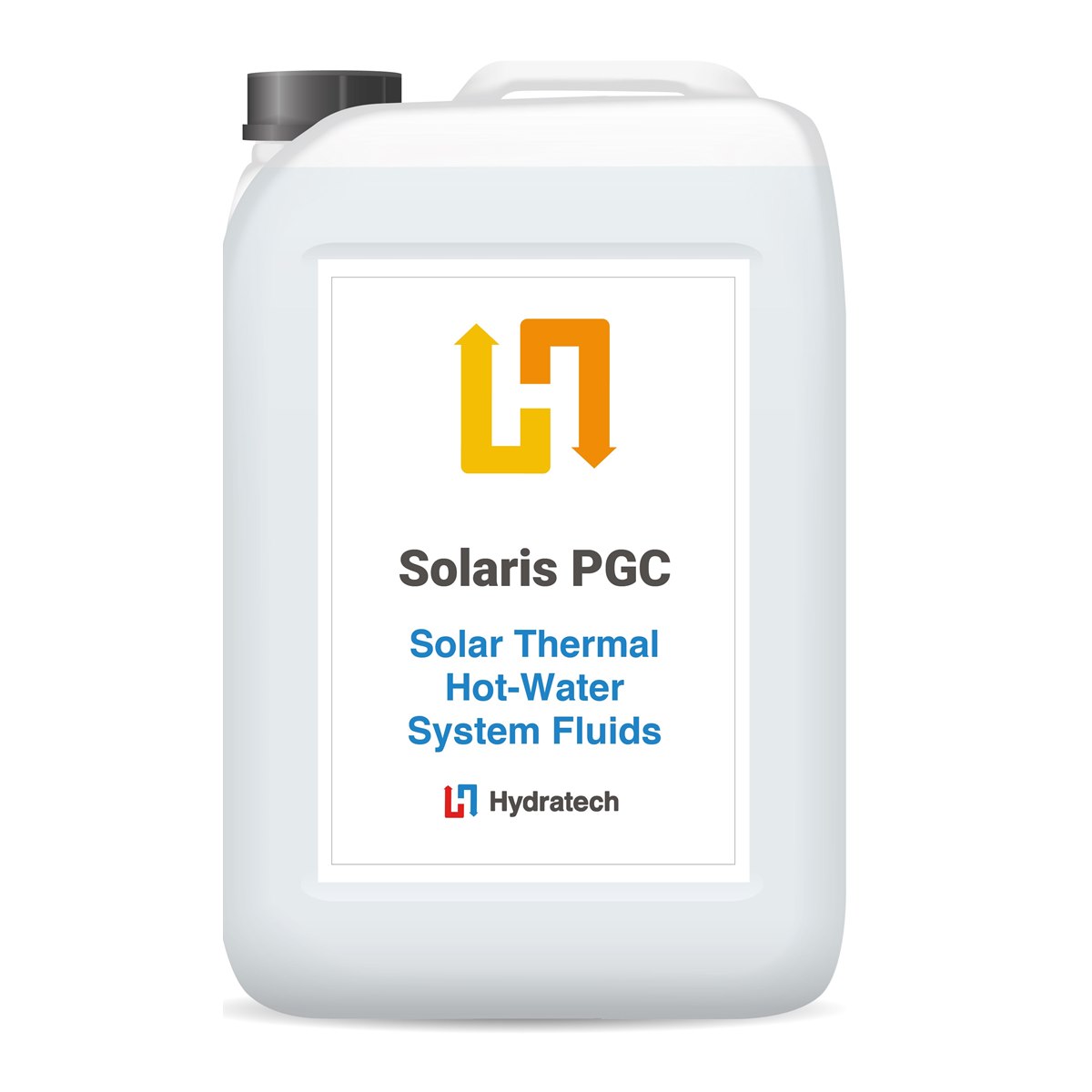 Solaris PGC
concentrate, 5L
Solar fluid FAQs
What is solar fluid?
A glycol-based heat transfer fluid that carries heat from solar thermal collectors to the hot water cylinder. It contains antifreeze to stop the collectors freezing and inhibitors that protect the system at high temperatures.
Should I buy ready-mixed or concentrate solar fluid?
Ready-mixed (Solaris DTX20 or PG20) is simplest: it goes straight in and protects to −20°C. Concentrate (Solaris DTX or PGC) lets you choose the protection level, down to −50°C, but must be mixed accurately with deionised water.
Can I top up with a different solar fluid?
Hydratech’s instruction is to top up only with the same Solaris fluid that’s already in the system. If you don’t know what’s in your system, contact us before adding anything.
How much Solaris DTX concentrate do I need?
In solar systems, Hydratech specifies a minimum of 35% of the total system volume and normally no more than 45%. 38% gives −25°C and 42% gives −30°C.
Is solar fluid toxic?
All four Solaris fluids are classified non-toxic. The DTX versions use Hydratech’s DeTox™ additive and were tested by an EPA-certified laboratory; the propylene glycol versions have an LD50 (oral, rat) of at least 15,000 mg/kg.
How long does solar fluid keep?
Unopened, Solaris fluids keep for at least 3 years in sealed containers, stored below 40°C and out of direct sunlight. In a working system, Hydratech recommends periodic sampling and testing.