
Biodegradable Hydraulic Oil and Bio Oils Explained: the Millers Bio Range
A burst hose on a digger beside a river, a forestry harvester working in a plantation, a winch on a boat deck: when hydraulic oil escapes in places like these, it goes straight into the soil or the water. That’s why more contractors, councils and machinery owners are asking for biodegradable hydraulic oil. This guide explains what bio oils are, why they’re used, their advantages, and the full Millers Oils bio range.
What is a bio oil?
Most hydraulic oils, chain oils and cutting oils are made from mineral oil, refined from crude oil. If they leak, they persist in the environment for a long time. A bio oil is built on a base that bacteria and other microorganisms naturally break down. Usually that’s a synthetic ester or a vegetable oil.
You’ll see a few terms used for these products:
- Readily biodegradable means the oil passes a strict laboratory test, such as OECD 301B, showing that microorganisms break it down quickly and largely to carbon dioxide and water.
- EAL (Environmentally Acceptable Lubricant) is the umbrella term for lubricants that are biodegradable and low in toxicity, for use where a leak could reach the environment.
- HEES is the ISO 15380 code for a hydraulic fluid based on synthetic esters, and it’s the type Millers uses for its SE BIO range.
ISO 15380 is the international standard for environmentally acceptable hydraulic fluids, and it groups them by base:
| ISO 15380 type | Base fluid |
|---|---|
| HETG | Vegetable oils (triglycerides), such as rapeseed oil |
| HEES | Synthetic esters: the base of Millers Millmax SE BIO |
| HEPG | Polyglycols |
| HEPR | Polyalphaolefins and related hydrocarbons |
Why use a biodegradable oil?
Bio oils are used wherever a leak or spill could do real damage, or where the oil is meant to end up in the environment:
- Work near water. Construction plant, dredging and bank work beside rivers, lakes and the coast, and marine deck equipment such as winches and cranes.
- Forestry and agriculture. Harvesters, forwarders and farm machinery working on soil, often far from a spill kit.
- Earth-moving and construction. Large excavators and loaders, where one burst hose can dump litres of oil on the ground.
- Total-loss jobs. Chainsaw bars, spray-mist cutting and sawing, where the oil is flung off or misted away by design. As the Millers data sheet for Bio Chain Bar Oil puts it, a biodegradable lubricant here is “desirable and in some instances mandatory”.
- Contract and tender requirements. Some clients and sites now specify an Environmentally Acceptable Lubricant. Check your contract or site rules.
The advantages of Millmax SE BIO
A bio oil is only worth using if it protects the machine as well as the environment. Millmax SE BIO is a fully synthetic ester hydraulic fluid, and according to the Millers data sheets it delivers on both:
Readily biodegradable, low toxicity
Over 80% biodegradation in both the OECD 301B and CEC L-33-T-82 tests (32, 46 and 68 grades), and formulated for low toxicity. The range is listed as EU Ecolabel compliant and meets the Swedish environmental hydraulic fluid standard SS 15 54 34.
Proper hydraulic performance
It meets DIN 51524-3 (HVLP) performance (excluding ASTM D4310), ISO 15380 (HEES), VDMA 24568 and the Denison SK-30320 specification, with anti-wear additives that protect pumps and valves under high pressure.
Very high viscosity index, so it saves energy
A viscosity index of around 190 means the oil’s thickness changes very little between a cold morning start and full working temperature. Millers says this cuts frictional losses and the power wasted pushing oil around, so it can lower fuel or electricity use.
Good cold starts, high flash point
Pour points go down to −35°C (SE BIO 68) and −40°C (SE BIO 46), so it flows quickly from cold. Flash points are at least 275–280°C.
Long, stable life
Synthetic esters resist heat and oxidation, and Millers rates SE BIO for “outstanding thermal and hydrolytic stability”, meaning it resists breakdown from heat and from water getting in.
Millmax SE BIO grades: 15, 32, 46 and 68
Like ordinary hydraulic oil, bio hydraulic oil comes in ISO viscosity grades. The number is the oil’s thickness at 40°C (see our viscosity grades guide). Always use the grade your machine’s manual specifies.
| Grade | Best for (Millers data sheet) | VI | Pour point | Availability |
|---|---|---|---|---|
| SE BIO 15 | Light mobile plant and precision control systems; excellent cold starts in cold or temperate climates | 192 | −55°C | To order |
| SE BIO 32 | General mobile and industrial hydraulics: construction plant, marine deck equipment, agricultural machinery, anywhere a leak could reach waterways or soil | 190 | −45°C | To order |
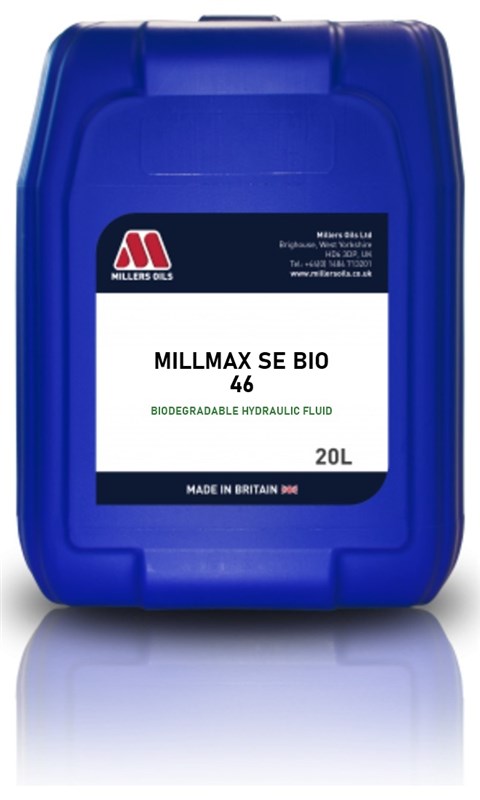
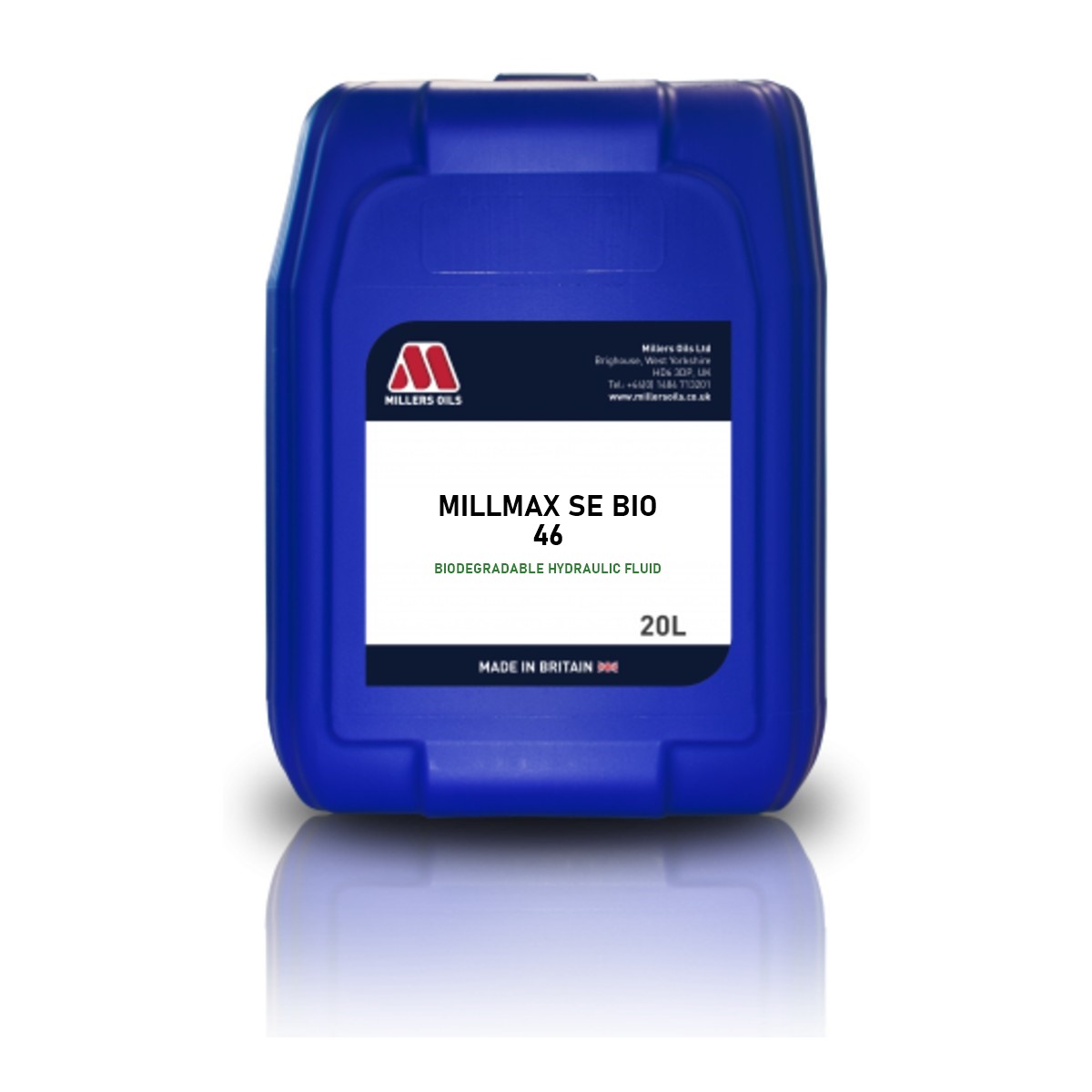
| SE BIO 46 | Medium to heavy-duty hydraulics: large construction machinery, earth-moving equipment, forestry harvesters, industrial machinery with changing pressures and temperatures | 189 | −40°C | In stock, 20L |
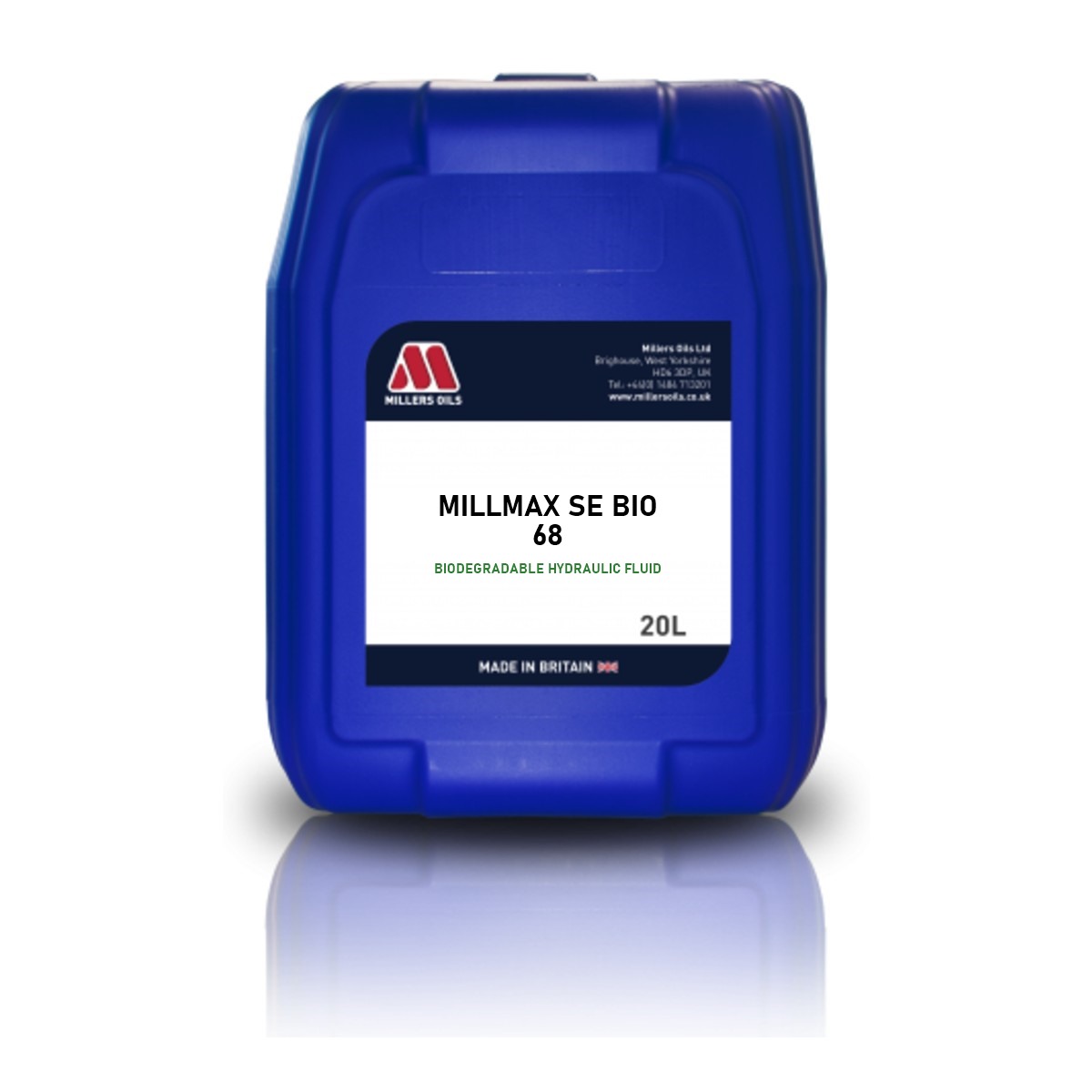
| SE BIO 68 | High-output, heavy-duty mobile and industrial systems: large high-power machinery, industrial presses, heavy offshore equipment, high temperatures and sustained loads | 198 | −35°C | In stock, 20L |
More Millers bio and ester-based oils
Millers’ bio range isn’t only hydraulic oil. These are all available to order through us:
| Product | What it is | Used for |
|---|---|---|
| Bio Chain Bar Oil | Vegetable oils and synthetic biodegradable ester, with an ashless EP (extreme pressure) additive; meets the OECD 301 biodegradability requirement | Chainsaw cutting bars and chains, a total-loss job where the oil ends up on the ground |
| Millicut J40 | Biodegradable ester-based neat cutting oil with added oxidation stability; very low misting, high flash point (230°C) | Spray-mist and total-loss machining, and sawing; also long life in recirculating systems |
| Millicut BioSyn Pro 10 | Low-viscosity neat cutting oil from 100% renewable synthetic esters; readily biodegradable, chlorine-free, with anti-mist additives | Precision machining on high-speed sliding-head machines and through-tool lubrication; steels including stainless, aluminium, brass and bronze |
| Millcool BioSyn 10 | Fully synthetic, ester-based water-soluble coolant; mineral-oil-free, boron-free, chlorine- and sulphur-free | Turning, milling, drilling, tapping and reaming steels, aluminium and cast iron |
For help choosing a cutting fluid, see our cutting, drilling and tapping fluids guide.
Switching a machine to bio hydraulic oil
Many machines can be converted, but plan it properly. Every drop of old mineral oil left in the system dilutes the new oil’s biodegradability.
Check with the machine maker
Confirm that a synthetic ester (HEES) fluid is approved for your machine, that the seals and hoses are compatible, and which ISO grade you need. If you’re not sure, ask us and we’ll check with Millers’ technical team.
Drain as completely as possible
Drain the old oil while it’s warm, including the reservoir, the lines and the cylinders where you can. The less mineral oil left behind, the better.
Change the filters
Fit new filters and clean the reservoir breather so the new oil starts clean.
Refill, bleed and recheck
Fill with Millmax SE BIO using clean equipment, cycle every function to purge the air, and top up. Label the filler cap so nobody tops it up with mineral oil.
Mistakes to avoid
- Topping up with mineral oil. It undoes the point of a bio system. Keep a can of the right bio oil with the machine.
- Assuming “bio” means weaker. Millmax SE BIO meets DIN 51524-3 performance and the Denison SK-30320 spec, so choose it on grade and approvals as you would any hydraulic oil.
- Letting water and dirt in. Keep containers sealed and stored under cover, and clean around the filler before opening it.
- Using the wrong grade. Bio or not, match the ISO grade in the manual.
- Treating it as a licence to leak. Bio oil reduces the harm from a spill; it doesn’t make spills acceptable. Fix leaks and keep a spill kit.
Bio oil FAQs
What is biodegradable hydraulic oil?
It’s a hydraulic fluid that microorganisms in soil and water break down naturally, so a leak does far less lasting harm than mineral oil. Millers Millmax SE BIO is a synthetic ester (HEES) fluid, and the 32, 46 and 68 grades show over 80% biodegradation in the OECD 301B test.
Is biodegradable hydraulic oil as good as mineral oil?
A good synthetic ester is. Millmax SE BIO meets DIN 51524-3 performance (excluding ASTM D4310), ISO 15380, VDMA 24568 and the Denison SK-30320 specification. Its very high viscosity index (around 190) keeps its thickness stable from cold starts to full working temperature.
Can I mix bio hydraulic oil with mineral hydraulic oil?
Don’t. Mixing in mineral oil reduces the biodegradability you’re paying for. When you convert a machine, drain the old oil as completely as possible and change the filters, and always top up with the same bio oil.
What does HEES mean?
HEES stands for Hydraulic Environmental Ester Synthetic. It’s the ISO 15380 class for environmentally acceptable hydraulic fluids based on synthetic esters. The other classes are HETG (vegetable oil), HEPG (polyglycol) and HEPR (polyalphaolefin and related).
Which grade of bio hydraulic oil do I need?
Use the ISO grade in your machine’s manual. ISO 46 is the most common all-rounder for construction, earth-moving and forestry machinery. ISO 68 is for heavier, hotter-running systems, and ISO 32 and 15 are for lighter systems and colder conditions.
Do you sell biodegradable hydraulic oil in Ireland?
Yes. We stock Millers Millmax SE BIO 46 and SE BIO 68 in 20 litre containers, and we can supply the rest of the Millers bio range to order, including SE BIO 15 and 32, Millmax HFD(u), Bio Chain Bar Oil and the bio cutting fluids. Contact us for prices and larger quantities.
More workshop guides: food-grade oils and greases, hydraulic oil guide: ISO 32, 46 or 68?, cutting and tapping fluids, oil viscosity grades explained and all industrial and workshop guides.