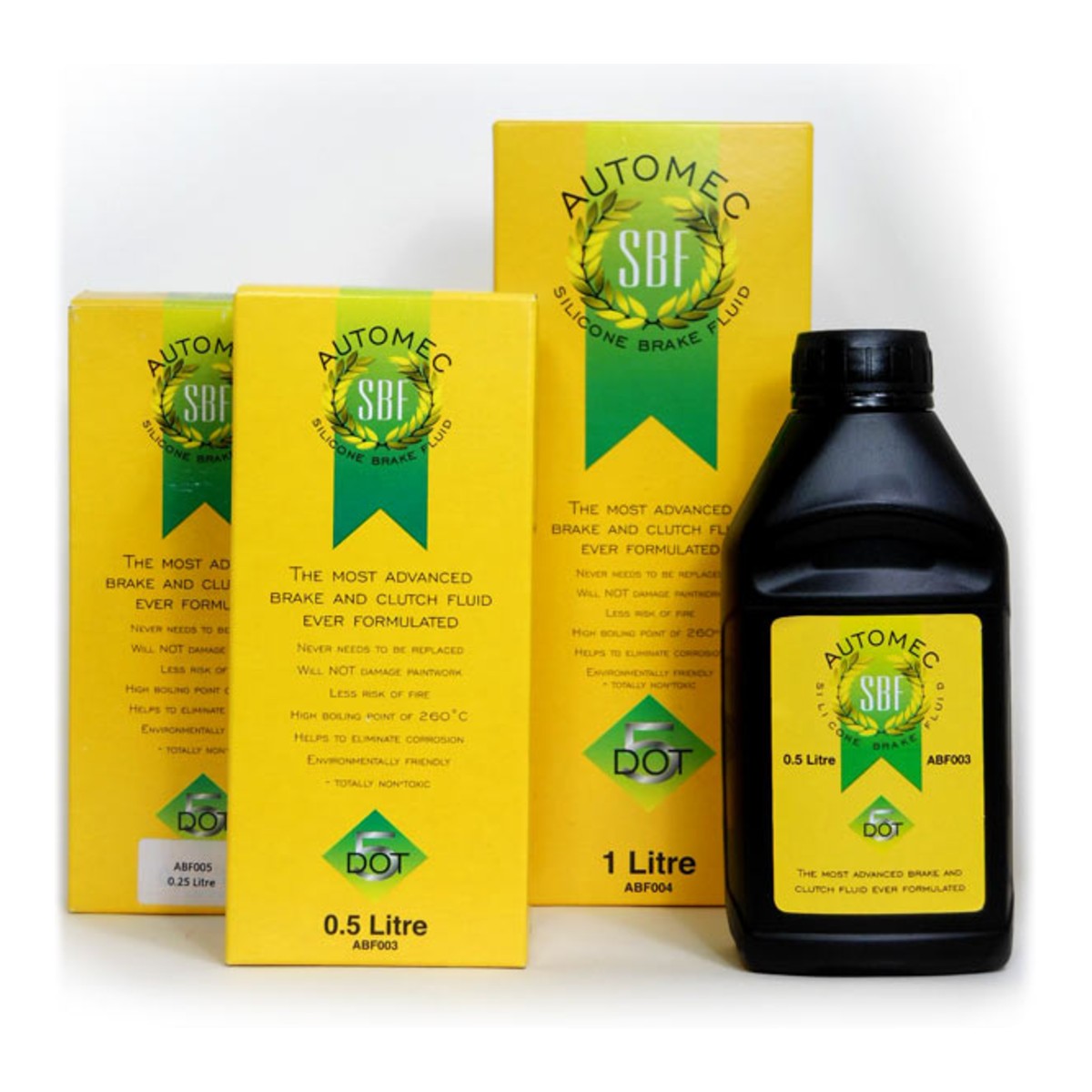
Automec DOT 5 Silicone Brake Fluid: Pros, Cons and When to Use It
The short version: Automec DOT 5 is a silicone brake fluid. It does not absorb moisture, it will not strip your paint, and it does not need changing — which makes it superb for a restored classic that spends time standing. It is not the right choice for a modern car with ABS, for competition use, or for topping up a system that already has normal brake fluid in it. Here is the honest picture.
First: DOT 5 is not DOT 5.1
This catches people out constantly, and it matters, so it is worth being blunt about it.
- DOT 3, DOT 4 and DOT 5.1 are all glycol-based. They mix with each other.
- DOT 5 is silicone-based. It does not mix with any of them.
The numbering suggests DOT 5.1 is an upgraded DOT 5. It is not — DOT 5.1 is a high-performance glycol fluid and has more in common with DOT 4 than with DOT 5. If you take one thing from this article, make it that.
Who are Automec?
Automec are a British firm who have been making brake pipe sets and silicone brake fluid for 50 years, and have supplied their DOT 5 silicone fluid around the world since 1982. It is the same type of fluid the US military specified for their light vehicles — largely because vehicles that sit for long periods are exactly where silicone shines.
The pros
It does not absorb water
This is the whole point. Ordinary glycol brake fluid is hygroscopic — it pulls moisture out of the air over time. That water lowers the boiling point, which is why glycol fluid should be changed every couple of years. Silicone does not absorb moisture, so its boiling point (Automec quote 260°C) is maintained for the life of the fluid, and in practice it does not need changing.
It will not damage paintwork
Spill glycol fluid on a wing and you have a paint problem in minutes. Silicone is harmless to paint. On a car you have just spent years and a lot of money restoring, that alone sells it.
It protects a car that stands
Because moisture is kept out, internal corrosion and seized cylinders are far less likely on a car that only comes out a few times a year. This is the single best reason to use it in a classic.
It is less of a fire risk
Silicone fluid does not ignite as readily as glycol.
The cons — and they are real
Water that does get in has nowhere to go
This is the flip side of not absorbing moisture. Glycol fluid takes on small amounts of water and holds it in suspension, spread through the system. Silicone does not — so any water that finds its way in stays as free water and settles at the lowest points, where it can corrode locally, freeze, or boil. A properly sealed system is important.
It can feel spongier, and it hates being rushed
Silicone is slightly more compressible than glycol and it entrains air far more readily — shake it or pump it hard and it will hold tiny bubbles. Bled carelessly you get a soft pedal, and people then blame the fluid. It needs slow, patient bleeding, and letting the fluid stand before use helps.
Not for ABS
Silicone fluid is generally not recommended for use in ABS systems. If your car has ABS, check the vehicle manufacturer’s specification and stick to what it calls for.
Not for competition
For track and stage work, what matters is a high wet boiling point and a firm, consistent pedal under repeated heavy braking. That is the job of a racing glycol fluid like Millers Racing Brake Fluid 320+, not silicone.
You cannot just pour it in
It costs more than standard fluid, and — most importantly — it cannot be mixed with what is already in there. Which brings us to the rule that matters most.
The golden rule: never mix it
Do not add DOT 5 silicone to a system containing glycol fluid, and do not add glycol to a system containing silicone. They are not compatible. Mixing can cause the fluid to gel and can affect seals, and you will not get the benefits of either.
To convert a car to silicone properly, the system needs to be completely free of the old fluid — realistically that means a full strip and rebuild with new or thoroughly cleaned components, or at the very least an exhaustive flush. The ideal moment is during a restoration, when the brake system is apart anyway and you are fitting new pipes and cylinders. That is when silicone makes the most sense and gives the least trouble.
So — when should you use it?
Good fit
- A classic or vintage car, particularly during or just after a brake system rebuild
- A car that is stored or only used occasionally — the standing-still case is where silicone earns its keep
- A restored or show car where paint protection matters
- Anyone who would rather not be changing brake fluid every two years
Wrong fit
- Any car with ABS, unless the manufacturer specifically permits it
- Competition, track days or hard road use — use a racing glycol fluid instead
- Topping up an existing glycol-filled system
- A tired system with old seals and corroded bores — fix the system first
What we would use instead
If silicone is not right for your car, the brake and clutch fluid range covers the alternatives: Millers Universal DOT 4 for everyday cars and vans, and Millers Racing Brake Fluid 300+ and 320+ for competition, where a high wet boiling point is what keeps the pedal firm.
Not sure?
Brakes are not the place to guess. If you are weighing up a conversion, or you are not certain what is in your system, ring us on 089 448 6626 — we build and service cars out of the same yard as the shop and would far rather talk it through than have you find out the hard way. Automec DOT 5 Silicone Brake Fluid is in Irish stock in 0.25L, 0.5L, 1L and 5L.