Heat Pump Antifreeze Explained: Which Glycol, How Much and How to Check It
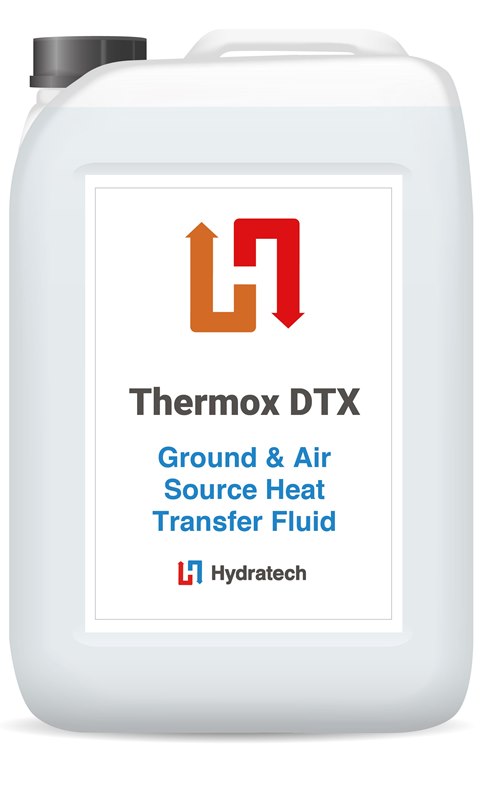
If you’re filling a new heat pump system, replacing old fluid or topping up, you’ll need the right heat pump antifreeze: a glycol-based heat transfer fluid that stops the system freezing and protects it from corrosion inside. This guide explains the different types, how much to add for the frost protection you need, and how to check the mix, using Hydratech’s Thermox range, which we stock here in Ireland.
Why does a heat pump need antifreeze?
Heat pump circuits carry a water-based fluid, and in Irish winters parts of that circuit can get cold enough to freeze. A ground source heat pump pulls heat out of a buried ground loop or borehole, so the fluid in that loop runs cold. In an air source system, any part of the water circuit that sits outdoors is exposed to frost, especially if the system stops during a cold snap. Frozen fluid expands and can split pipework and damage the heat exchanger.
A heat pump antifreeze does two jobs: the glycol lowers the freezing point, and the inhibitors in it protect the metals in the system from corrosion, scale and biological fouling. Every Thermox fluid contains long-life inhibitors that meet the BS6580 and ASTM D1384 corrosion standards. Always follow your heat pump manufacturer’s guidance on whether antifreeze is needed and what strength to use.
The types of heat pump antifreeze
Heat pump antifreeze comes in four main types. The ratings below are Hydratech’s own, from A (best) to E.
| Type | Thermox fluid | Toxicity | Efficiency | Antifreeze | % for −10°C | Best for |
|---|---|---|---|---|---|---|
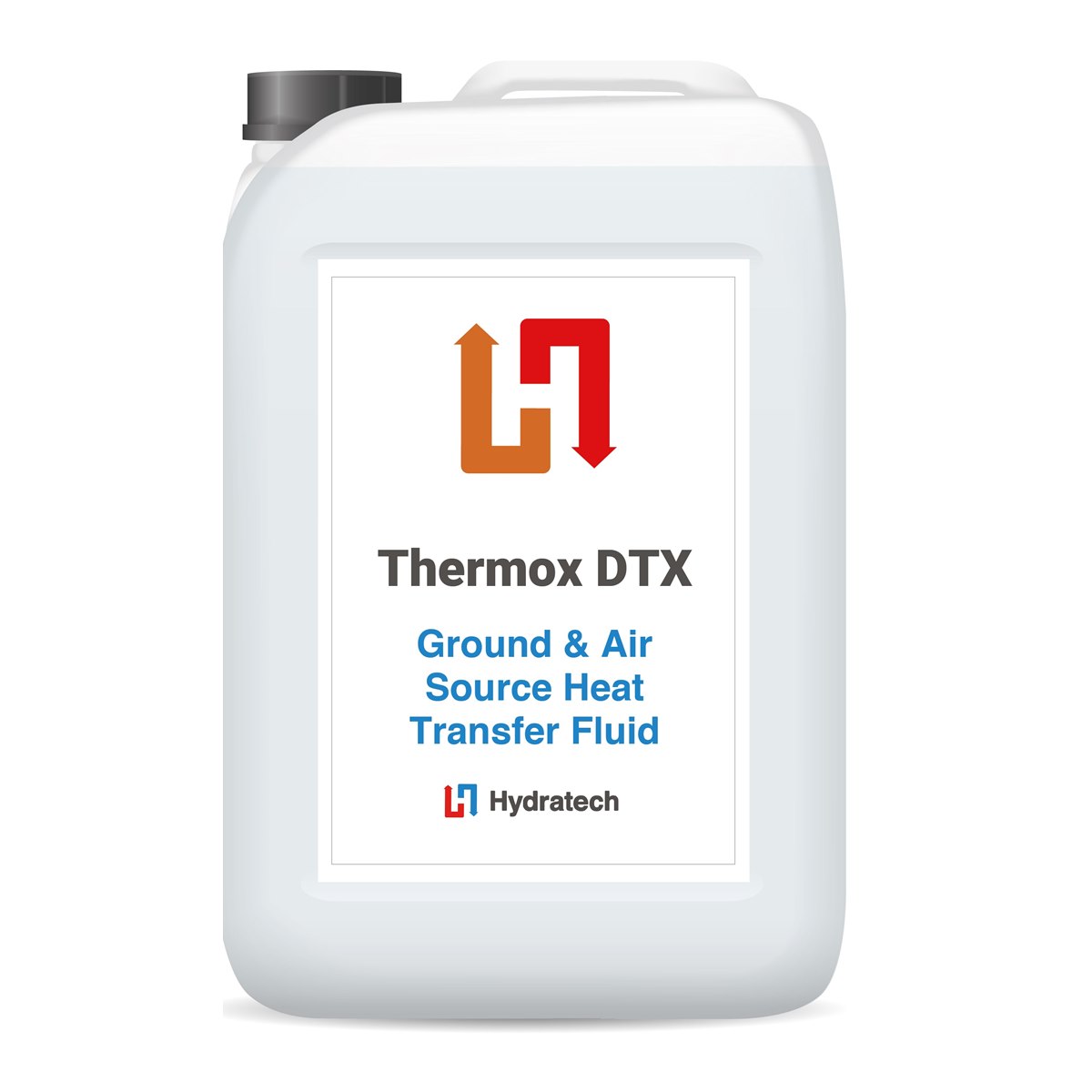
| Detoxified ethylene glycol (DTX) | Thermox DTX | A Non-toxic | B | A | 22% | Most systems, new fills, homes |
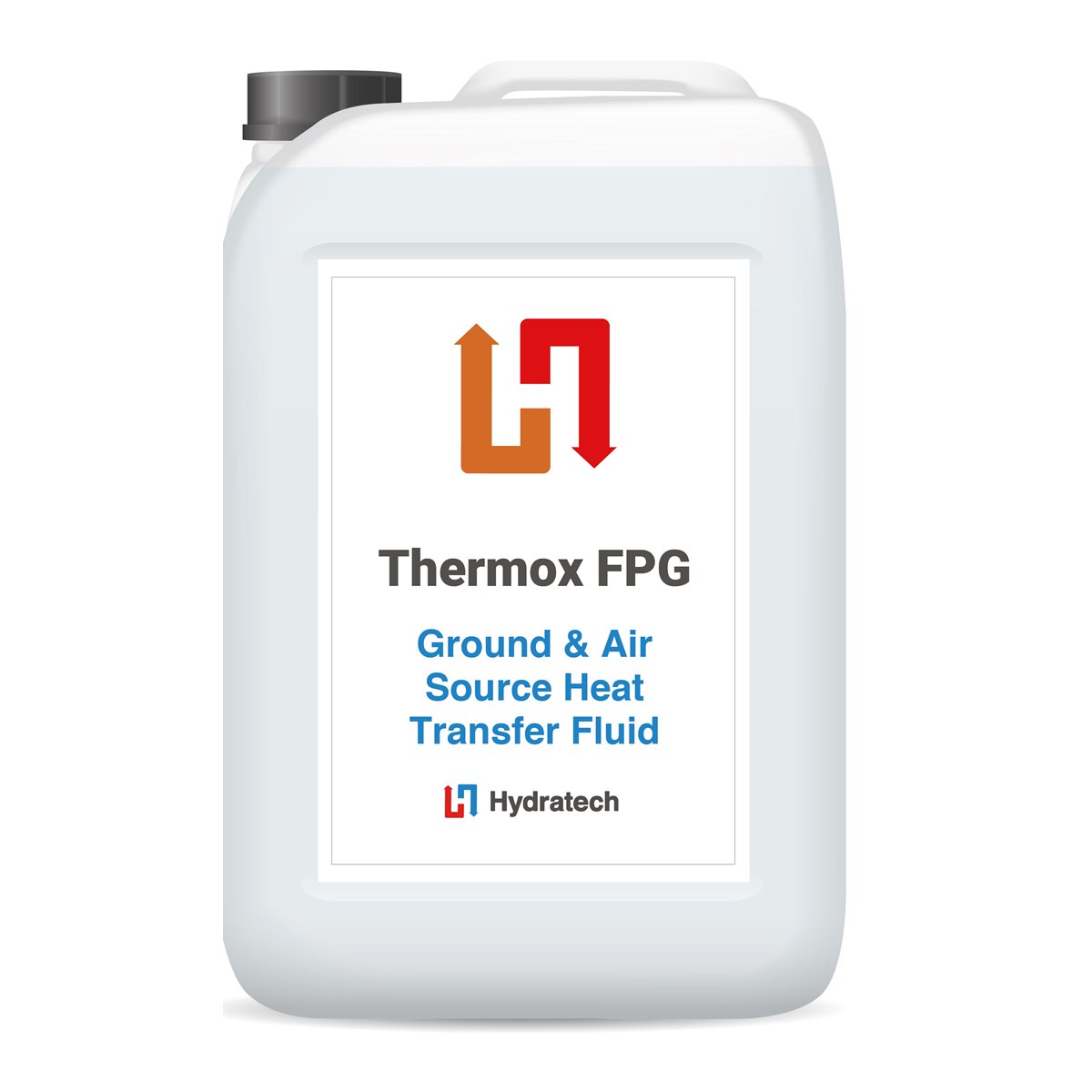
| Propylene glycol (MPG) | Thermox FPG | A Non-toxic | C | B | 25% | Where MPG is specified, or topping up an MPG system |
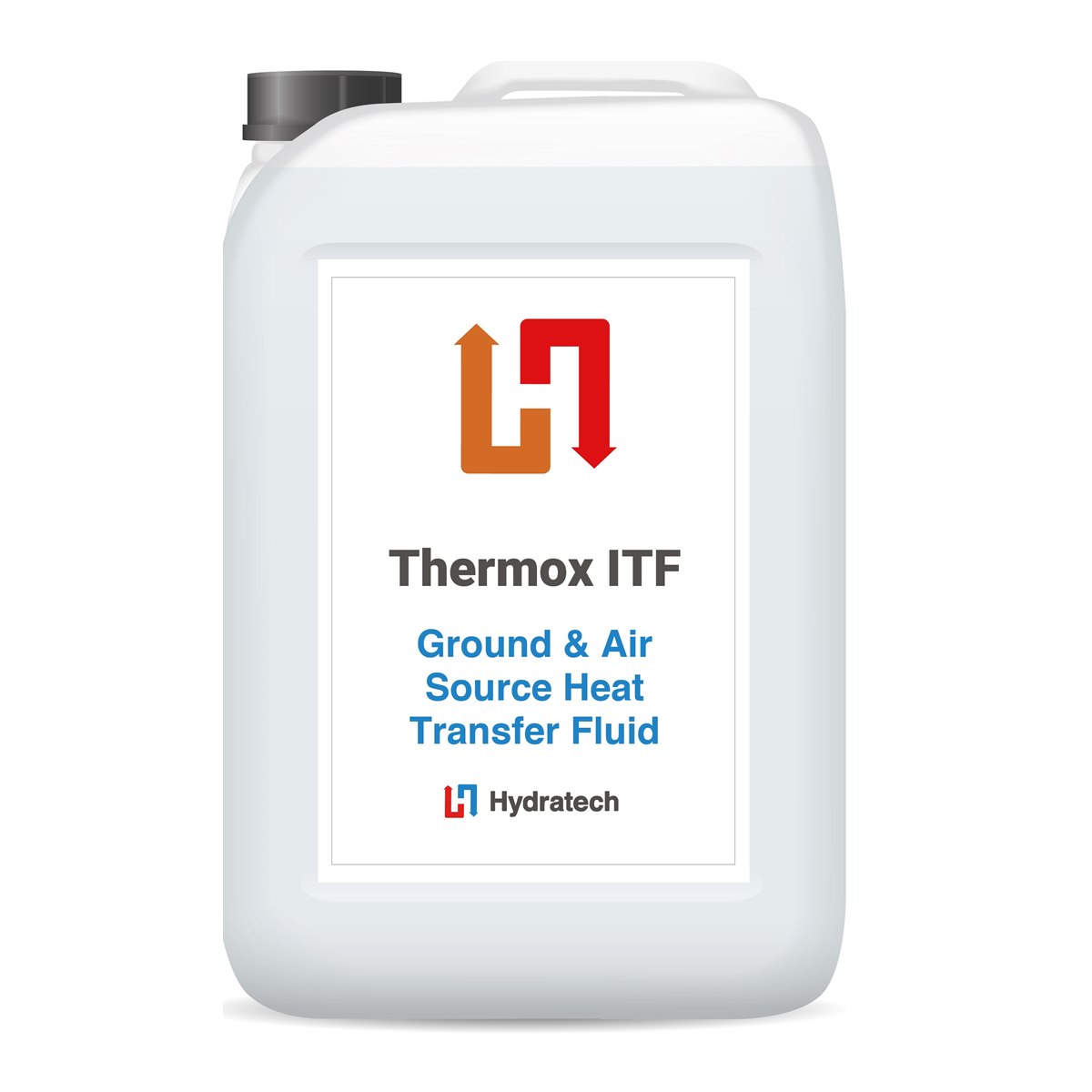
| Ethylene glycol (MEG) | Thermox ITF | D Harmful | B | A | 20% | Commercial and industrial systems where toxicity isn’t an issue |
| Plant-based | Thermox FXC2 (to order) | A Non-toxic | C | B | 25% | Where low environmental impact is the priority |
What is DTX, and why is it non-toxic?
Ethylene glycol is the better heat transfer fluid: it moves heat more efficiently, pumps more easily at low temperatures, and you need less of it for the same frost protection. Its drawback is toxicity. Hydratech’s DTX fluids add a patented additive, DeTox™, which stops ethylene glycol being broken down into toxic by-products if swallowed. Thermox DTX has been tested and classified non-toxic by an EPA-certified laboratory, so you get ethylene glycol’s performance with a non-toxic classification.
Propylene glycol (Thermox FPG) is the traditional non-toxic choice. It works well but needs a higher concentration for the same protection, and it is more viscous when cold. Plain ethylene glycol (Thermox ITF) is efficient and the most economical, but it is classed as harmful, so keep it for commercial and industrial systems where toxicity is not an issue.
How much antifreeze do I need?
Antifreeze is measured as a percentage of the total system volume, not as a ratio to the water you add. Decide on the lowest temperature you need to protect against, then read off the strength. Your installer’s commissioning sheet or the system documentation should give the total system volume.
| Frost protection | Thermox DTX | Thermox FPG | Thermox ITF | Thermox FXC2 |
|---|---|---|---|---|
| −10°C | 22% | 25% | 20% | 25% |
| −15°C | 28% | 33% | 27% | 32% |
| −20°C | 33% | 39% | 32% | 38% |
| −25°C | 38% | 44% | 37% | 43% |
| −30°C | 42% | 48% | 41% | 48% |
| −35°C | 46% | 53% | 45% | 52% |
| Minimum dose | 22% | 25% | 20% | 25% |
How to fill a system with heat pump antifreeze
Clean the system first
Hydratech advises that all pipework should be clean and free of debris and biological contamination before commissioning, as set out in BSRIA guide BG 29/2012. Fresh antifreeze in a dirty system won’t protect it properly.
Work out the volume and strength
Find the total system volume and choose your frost protection from the table above. Multiply the volume by the percentage to get the litres of concentrate you need.
Use the right water
Dilute with deionised, distilled or ultrapure water. Avoid water high in calcium salts or chlorides, which work against the inhibitors.
Fill and keep air out
Fill the system following your heat pump manufacturer’s instructions. Air ingress should be kept to a minimum to limit corrosion, and a pressurised system is best.
Check the strength
Once the fluid has circulated, check the concentration with a recently calibrated refractometer (see the readings below) and adjust if needed.
Checking the mix with a refractometer
A refractometer reads the refractive index of a drop of system fluid, which tells you the glycol strength. These are Hydratech’s readings for Thermox DTX:
| Frost protection | Thermox DTX strength | Refractive index |
|---|---|---|
| −10°C | 22% | 1.35590 |
| −15°C | 28% | 1.36240 |
| −20°C | 33% | 1.36780 |
| −25°C | 38% | 1.37310 |
| −30°C | 42% | 1.37740 |
| −35°C | 46% | 1.38150 |
Mistakes to avoid
- Mixing different fluids. Top up with the same type of fluid that’s already in the system. If you don’t know what’s in it, ask us before adding anything.
- Diluting with hard tap water. Water high in calcium salts or chlorides works against the inhibitors. Use deionised, distilled or ultrapure water.
- Going below the minimum dose. Below 22% for DTX (25% for FPG), you lose frost protection.
- Overdoing it. The maximum doesn’t normally exceed 60%. More isn’t better.
- Guessing the strength. Check it with a refractometer rather than assuming the mix is right.
- Using a fluid not made for the job. Check your heat pump manufacturer’s fluid specification, and use a fluid designed for heat pump systems.
Hydratech Thermox heat pump antifreeze
Heat pump antifreeze FAQs
Which antifreeze is best for a heat pump?
For most systems, a non-toxic detoxified ethylene glycol such as Thermox DTX. Hydratech rates it A overall: it transfers heat better than propylene glycol and needs a lower concentration for the same protection. Use propylene glycol (Thermox FPG) if it’s specified or already in the system.
How much glycol do I need for −10°C?
22% of the total system volume with Thermox DTX, 25% with Thermox FPG, or 20% with Thermox ITF.
Is heat pump antifreeze toxic?
It depends on the type. Thermox DTX, FPG and FXC2 are classified non-toxic. Plain ethylene glycol, such as Thermox ITF, is classed as harmful and is meant for commercial and industrial systems where toxicity isn’t an issue.
Can I mix propylene glycol and DTX?
Top up with the same type of fluid that’s already in the system. If you want to change fluid type, or you don’t know what’s in the system, contact us first.
How do I check the antifreeze strength?
Use a recently calibrated refractometer and compare the reading with the refractive index table on the fluid’s data sheet. For Thermox DTX, a reading of 1.35590 corresponds to 22% (−10°C).
How long does heat pump antifreeze keep?
Unopened, Thermox fluids keep for at least 3 years in sealed containers, stored below 40°C and out of direct sunlight. Once in a system, Hydratech recommends periodic sampling and testing to make sure the inhibitor levels are being maintained.