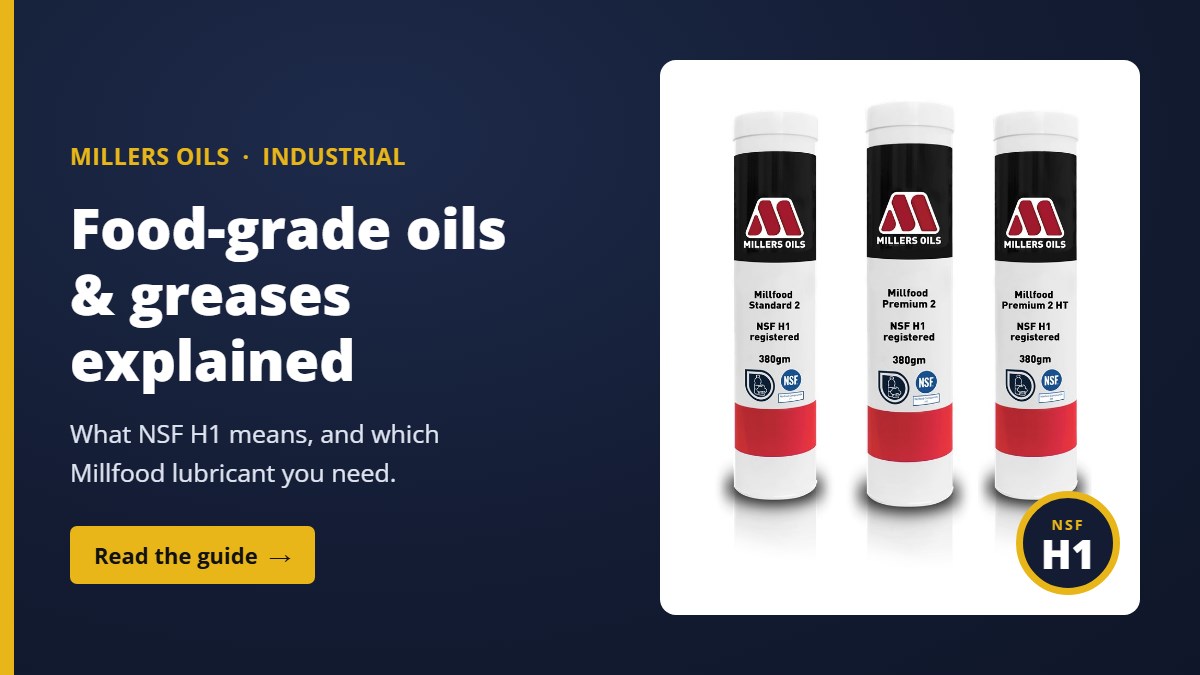
Food-Grade Lubricants Explained: NSF H1 Oils and Greases from Millers Millfood
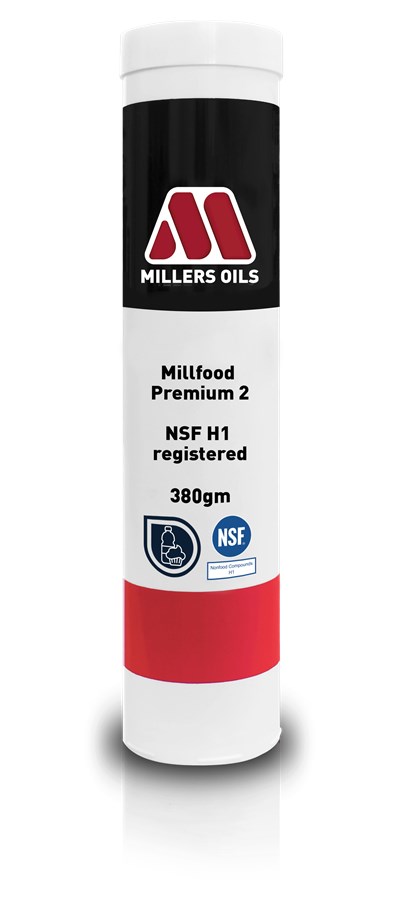
Bakeries, dairies, meat plants, breweries, bottling lines and packaging machinery all need lubricating, and all of them sit right beside food. If a drop of ordinary oil or grease drips off a conveyor or gearbox onto the product, that’s a contamination problem. Food-grade lubricants exist for exactly this. This guide explains what food grade and NSF H1 mean, and how to choose from the Millers Oils Millfood range of oils and greases.
What does food grade mean?
In the food industry, “food grade” usually means a lubricant is NSF registered. NSF International runs the registration scheme most food and drink plants work to, and it sorts lubricants into categories:
| Category | What it means | Where it’s used |
|---|---|---|
| H1 | Lubricants for use where incidental food contact is possible | On and around food-processing and packaging machinery: the one to ask for |
| H2 | Lubricants for use where there’s no possibility of food contact | Machinery in food plants located away from the food |
| H3 | Edible, soluble oils | Cleaning and rust prevention on items such as hooks and trolleys |
Every product in the Millers Millfood range is NSF H1 registered and made only from FDA-listed ingredients, so it can be used where there’s a chance of incidental contact with food. Each product has its own NSF registration number, listed below, which is useful for your food-safety records and audits.
Why use food-grade oil and grease?
- Food safety. Wherever a lubricant could drip, splash or be carried onto food or packaging, an H1 product removes a contamination risk.
- Audits and customers. Food-safety plans and auditors usually expect H1 lubricants in food areas, backed by registration numbers and data sheets.
- Allergen control. Millers states that every Millfood product contains no genetically modified ingredients and no nut oil or nut derivatives.
- One range for the whole plant. Millfood covers hydraulics, compressors, gearboxes, chains and bearings, so a site can switch over completely and avoid mix-ups.
- Beyond food. Clean, non-staining food-grade oils are also used in pharmaceutical, cosmetic and packaging plants, and in other industries where a clean oil is preferred.
Millfood food-grade oils
| Product | Use it for | Key facts (Millers data sheet) | NSF H1 no. |
|---|---|---|---|
| Millfood MP Synth 32, 46, 68, 100 | Hydraulic systems and compressors | Fully synthetic PAO multipurpose oil. Up to 8,000 hours service in compressors. Viscosity index 140, DIN 51524 HVLP. Operating range down to −54°C (32 and 46) and up to +240°C. | 125908, 125909, 125910, 137965 |
| Millfood Hydraulic Oil 32, 46 | Hydraulic systems | Blend of synthetic oils, non-toxic, low foaming, high viscosity index. DIN 51524 HVLP. −20°C to +150°C. | 125905, 125906 |
| Millfood Gear Oil 150, 320 | Gearboxes | Fully synthetic, with anti-wear, corrosion protection and water separation. Tacky, so it protects gears from start-up. FZG stage 12. −30°C to +200°C (150) or +240°C (320). | 125901, 125902 |
| Millfood 220 Chain & Gear Oil | Conveyor and drive chains, gearboxes and reduction units | Fully synthetic and adhesive. Penetrates links and pins, with a no-drip, no-fling formula and high water resistance. FZG stage 12. −30°C to +240°C. | 125891 |
Millfood food-grade greases
| Grease (all NLGI 2) | Best for | Key facts (Millers data sheet) | NSF H1 no. |
|---|---|---|---|
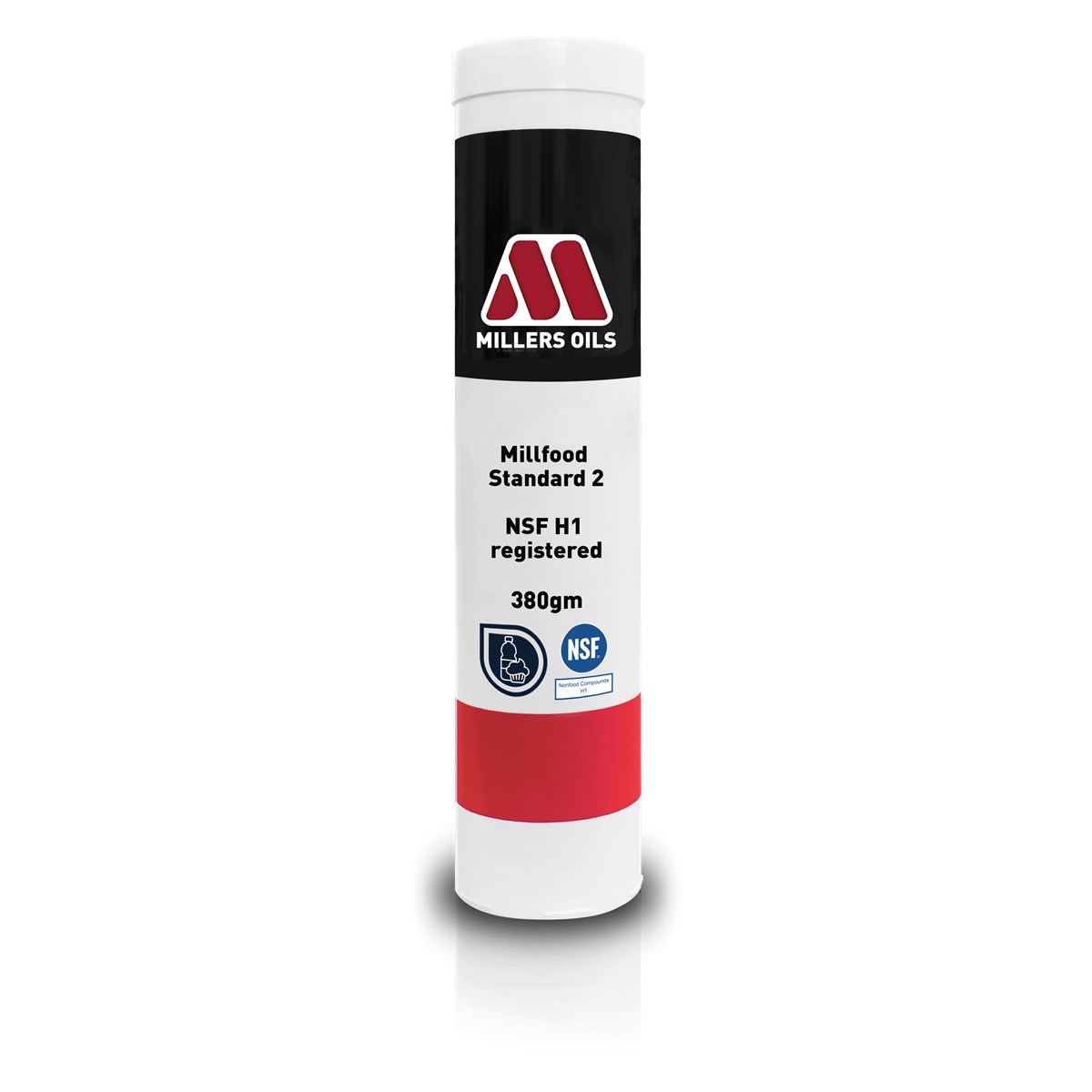
| Millfood Standard 2 | General bearings and slides where the plant is washed down often | Calcium-thickened, white-oil base, high water resistance, anti-wear and EP additives. −20°C to +110°C. | 125897 |
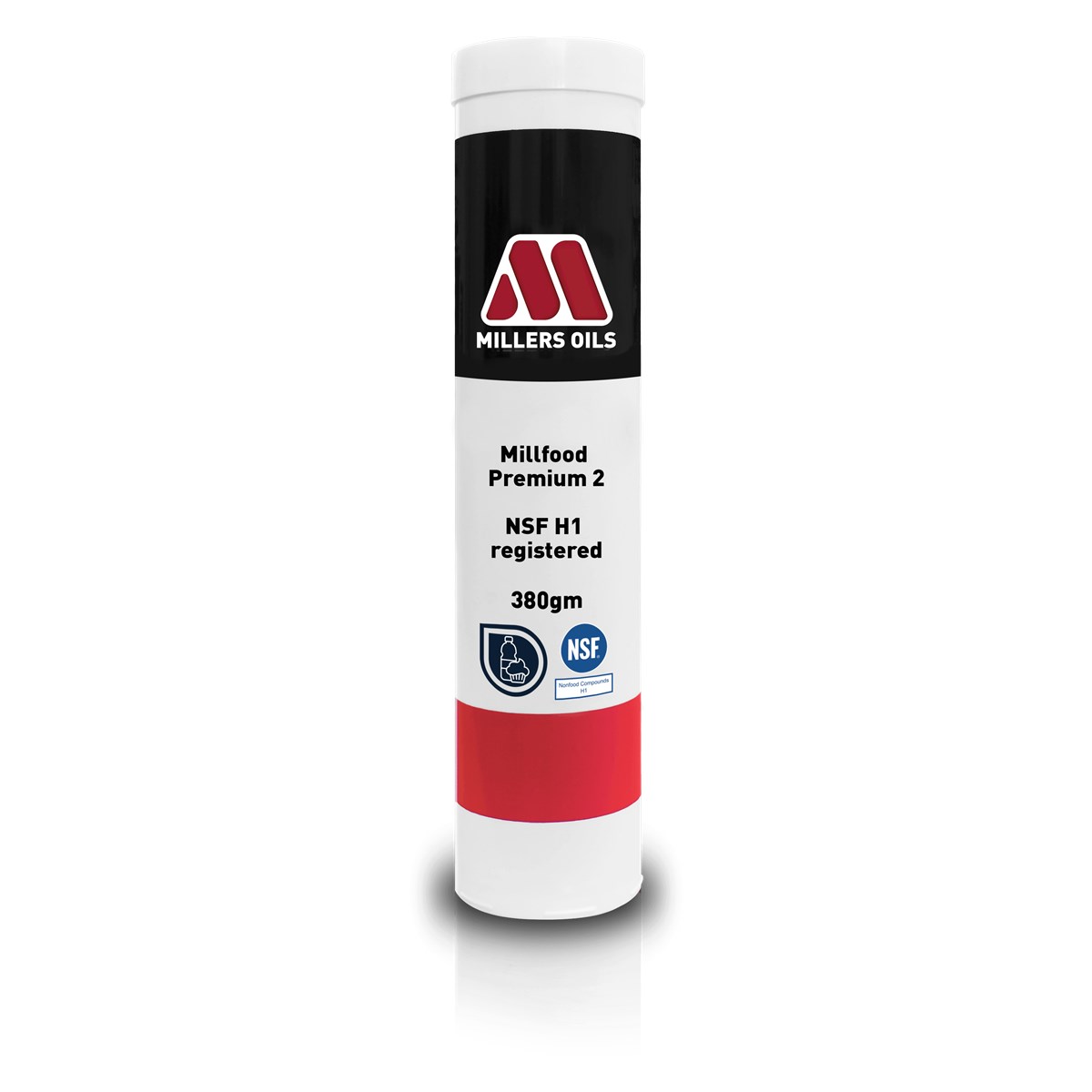
| Millfood Premium 2 | One grease for most jobs: heavy loads, extreme temperatures, wet or dusty conditions | Aluminium complex with synthetic base oil, EP additives and PTFE. Water washout under 1%, four-ball weld load 400kg. −50°C to +170°C. | 125900 |
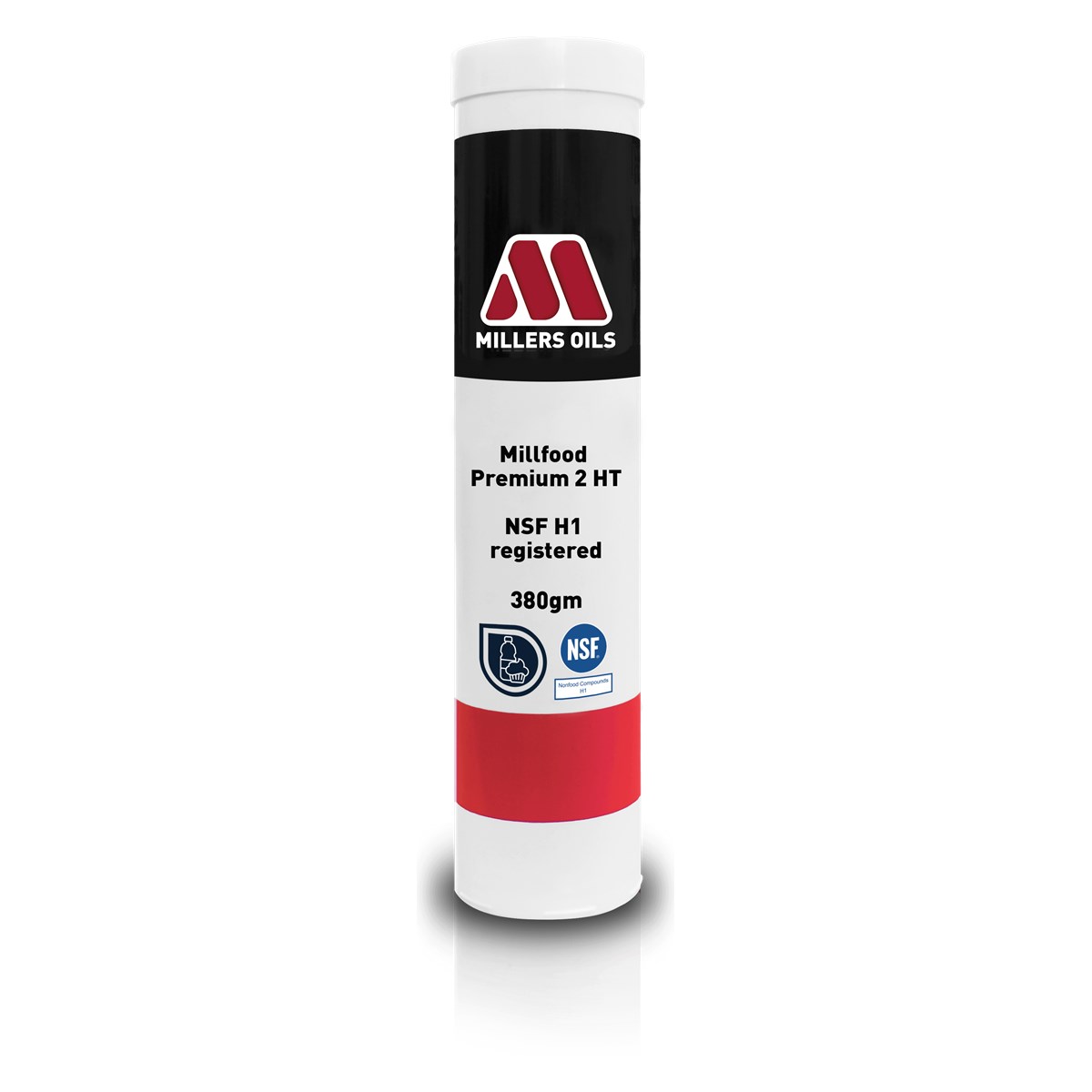
| Millfood Premium 2 HT | High temperatures: ovens and dryers up to 220°C | Silicone grease with PTFE. Reduced carbon deposits, compatible with most rubber seals and resistant to a wide range of cleaning chemicals. −20°C to +220°C. | 125895 |
Millers says Millfood Premium 2’s wide performance range lets most food plants rationalise to one grease. Keep Premium 2 HT for the hot spots. For more on grease types and NLGI grades, see our guide which grease do I need?
Which Millfood product do I need?
| What you’re lubricating | Millfood product |
|---|---|
| Hydraulic system | Millfood MP Synth (ISO 32, 46, 68 or 100) or Millfood Hydraulic Oil (ISO 32 or 46), in the grade your machine specifies |
| Air compressor | Millfood MP Synth, in the grade the compressor maker specifies |
| Gearbox or reduction unit | Millfood Gear Oil 150 or 320, or Millfood 220 Chain & Gear Oil |
| Conveyor or drive chain | Millfood 220 Chain & Gear Oil, applied sparingly by brush, can or automatic lubricator |
| Bearings and slides, frequent wash-down | Millfood Standard 2 |
| Bearings and slides, heavy loads or a wide temperature range | Millfood Premium 2 |
| Ovens, dryers and other hot spots | Millfood Premium 2 HT (up to 220°C) |
Always match the viscosity grade and type in your equipment manual. Not sure what the numbers mean? See our viscosity grades guide, hydraulic oil guide and compressor oil guide.
How to switch a machine to food-grade lubricants
List every lubrication point
Walk the line and note each hydraulic system, compressor, gearbox, chain and grease point, with the type and grade the manual calls for.
Purge the old oil
Millers recommends purging the system of the previous oil before filling with Millfood. Drain thoroughly, change the filters, and refill with clean equipment.
Flush out the old grease
Pump in the new food-grade grease until it comes out clean at the bearing or seal, then wipe away the excess. Greases with different thickeners don’t always mix well, so get the old grease out rather than greasing on top of it.
Label and keep records
Label grease guns, oil cans and fill points so only H1 products go into food-area machinery, and file the data sheets and NSF numbers with your food-safety records.
Mistakes to avoid
- Keeping H1 and non-food lubricants in the same store or gun. Use separate, clearly labelled grease guns, cans and storage.
- Topping up with whatever’s to hand. One fill of ordinary oil means the machine is no longer running on an H1 lubricant.
- Over-greasing. Excess grease squeezes out and can end up where it shouldn’t. Apply the right amount and wipe off the surplus.
- Using the wrong grade. Food grade or not, match the viscosity and NLGI grade the machine maker specifies.
- Assuming “white” means food grade. Colour proves nothing. Check for NSF H1 registration on the data sheet.
Food-grade lubricant FAQs
What is a food-grade lubricant?
It’s an oil or grease made for machinery in food, drink, pharmaceutical and packaging plants, where it might accidentally contact food. In practice, food grade usually means NSF H1 registered. Every product in the Millers Millfood range is NSF H1 registered and made from FDA-listed ingredients.
What’s the difference between NSF H1 and H2?
H1 lubricants are registered for use where incidental food contact is possible. H2 lubricants are only for machinery where there’s no possibility of contact with food. For anything on or near a food line, use H1.
Which food-grade grease should I use?
For most jobs, Millfood Premium 2: an aluminium complex grease with PTFE, rated −50°C to +170°C. Use Millfood Standard 2 for general bearings in plants that are washed down often, and Millfood Premium 2 HT for ovens and dryers up to 220°C.
Is there a food-grade hydraulic oil?
Yes. Millfood Hydraulic Oil (ISO 32 and 46) and Millfood MP Synth (ISO 32, 46, 68 and 100) are both NSF H1 registered and meet DIN 51524 HVLP. MP Synth is fully synthetic and can also be used in compressors.
Are Millfood lubricants free of nuts and GM ingredients?
Yes. The Millers data sheets state that Millfood products contain no genetically modified ingredients and no nut oil or nut derivatives.
Can I buy food-grade oil and grease in Ireland?
Yes. We supply the full Millers Millfood range to order: hydraulic, compressor, gear and chain oils and three food-grade greases. Contact us with what you’re lubricating and we’ll recommend the right product and pack size.
More workshop guides: which grease do I need?, biodegradable hydraulic oil and bio oils, hydraulic oil guide, compressor oil guide and all industrial and workshop guides.